AWS Backend Architecture Guide: Build Less, Scale More
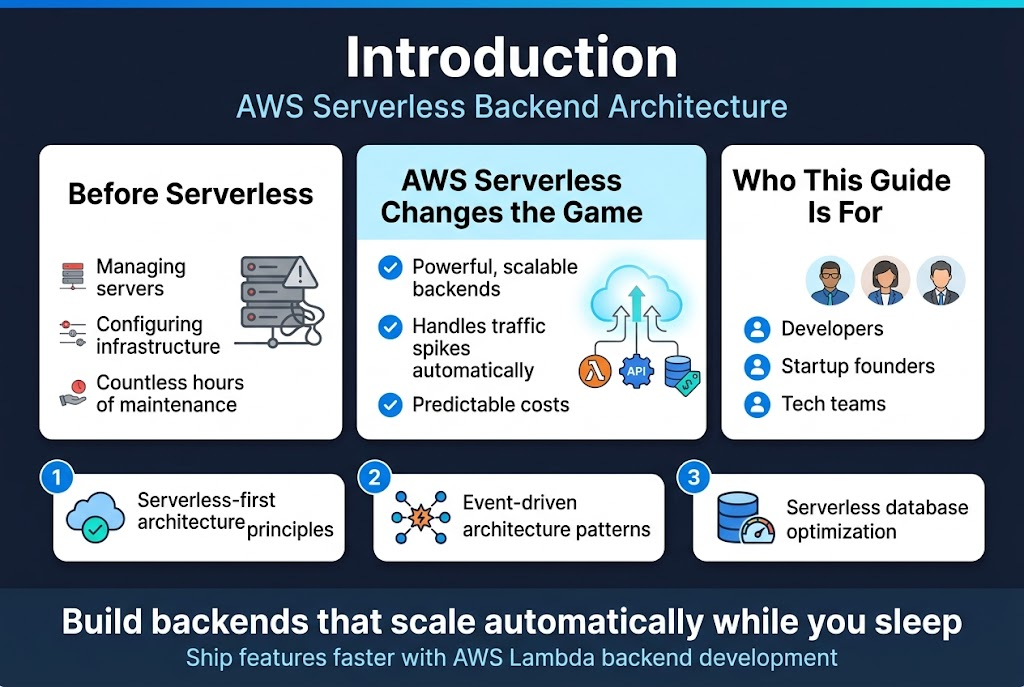
Building a robust backend used to mean managing servers, configuring infrastructure, and spending countless hours on maintenance. AWS serverless services have changed the game completely. Now you can create powerful, scalable backends that handle traffic spikes without breaking a sweat—or your budget.
This AWS backend architecture guide is for developers, startup founders, and tech teams who want to stop wrestling with infrastructure and start shipping features faster. You’ll learn how to build serverless systems that grow with your business while keeping costs predictable.
We’ll walk through serverless-first architecture principles that help you choose the right AWS services for each job. You’ll discover event-driven architecture patterns that handle real-world complexity without the headaches. Plus, we’ll cover serverless database optimization techniques that keep your app lightning-fast as your user base explodes.
Ready to build backends that scale automatically while you sleep? Let’s dive into the strategies that turn AWS Lambda backend development from overwhelming to effortless.
Serverless-First Architecture Principles
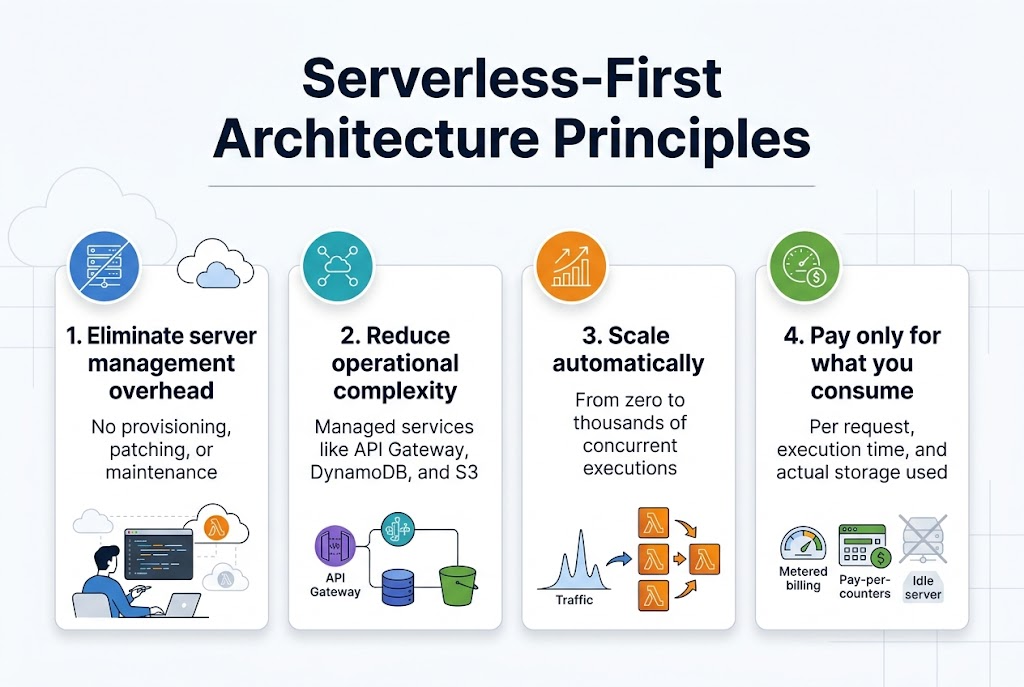
Eliminate server management overhead completely
AWS Lambda and serverless architecture guide you away from traditional server provisioning, patching, and maintenance tasks. Your development team focuses purely on writing business logic while AWS handles infrastructure scaling, security updates, and runtime management automatically.
Reduce operational complexity through managed services
AWS serverless services like API Gateway, DynamoDB, and S3 remove the need for complex infrastructure configurations. These managed components integrate seamlessly, eliminating the operational burden of managing databases, load balancers, and storage systems while providing enterprise-grade reliability.
Scale automatically based on actual demand
Serverless architecture patterns respond instantly to traffic spikes without pre-provisioning resources. Lambda functions scale from zero to thousands of concurrent executions within seconds, while services like DynamoDB automatically adjust throughput based on real-time demand patterns.
Pay only for resources you actually consume
AWS cost optimization becomes straightforward with serverless billing models that charge per request, execution time, and actual storage used. You avoid paying for idle servers during low-traffic periods, making this approach particularly cost-effective for applications with variable or unpredictable workloads.
Core AWS Services for Minimal Backend Development
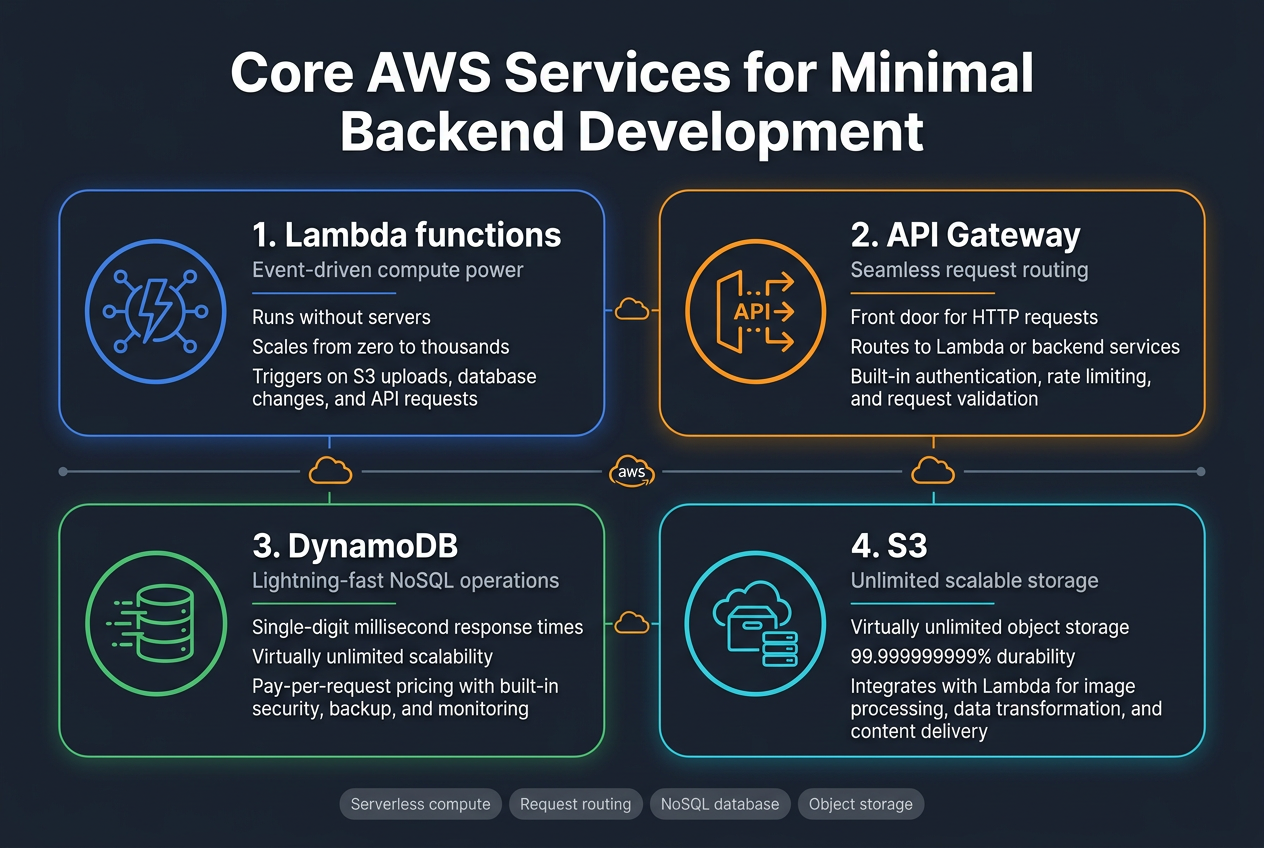
Lambda functions for event-driven compute power
AWS Lambda transforms your backend into a powerless, cost-effective engine that responds instantly to events. This serverless compute service automatically scales from zero to thousands of concurrent executions without provisioning servers. Lambda functions integrate seamlessly with other AWS services, triggering business logic when files upload to S3, database records change, or API requests arrive.
API Gateway for seamless request routing
API Gateway acts as your application’s front door, handling HTTP requests and routing them to appropriate Lambda functions or backend services. It provides built-in authentication, rate limiting, and request validation while automatically scaling to handle traffic spikes. The service transforms complex routing logic into simple configuration, reducing development time and eliminating infrastructure management.
DynamoDB for lightning-fast NoSQL operations
DynamoDB delivers single-digit millisecond response times with virtually unlimited scalability for your AWS serverless services. This fully managed NoSQL database automatically partitions data across multiple servers and provides built-in security, backup, and monitoring. Its pay-per-request pricing model aligns perfectly with serverless applications, eliminating capacity planning and reducing costs.
S3 for unlimited scalable storage solutions
Amazon S3 provides virtually unlimited object storage with 99.999999999% durability, making it the backbone of modern scalable backend design. Beyond simple file storage, S3 integrates with Lambda for automatic image processing, data transformation, and content delivery. Its multiple storage classes optimize costs while lifecycle policies automatically move data to cheaper tiers.
Event-Driven Design Patterns That Scale
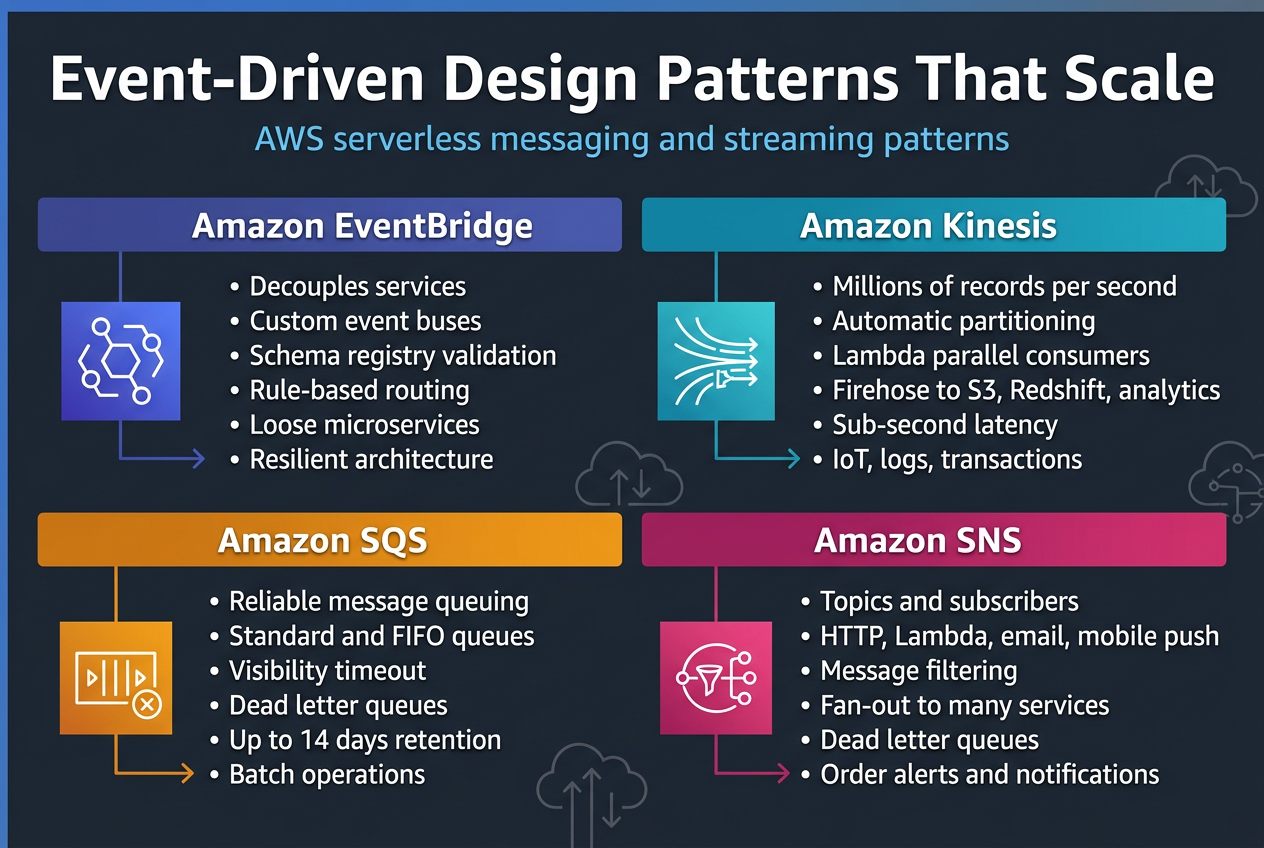
Decouple services using Amazon EventBridge
Amazon EventBridge acts as your AWS backend architecture’s central nervous system, routing events between services without tight coupling. Custom event buses separate concerns while built-in schema registry validates data formats automatically.
EventBridge transforms monolithic applications into loosely connected microservices that scale independently. Rule-based routing eliminates complex service dependencies, making your serverless architecture guide implementation more maintainable and resilient to failures.
Process data streams with Amazon Kinesis
Kinesis Data Streams handles millions of records per second with automatic partitioning and real-time processing capabilities. Configure shard scaling based on throughput requirements while Lambda functions consume stream data in parallel.
Data Firehose delivers streaming data directly to S3, Redshift, or analytics services without custom code. This event-driven architecture pattern processes IoT telemetry, user activity logs, and financial transactions with sub-second latency.
Queue messages efficiently with Amazon SQS
SQS provides reliable message queuing with automatic scaling and dead letter queue handling for failed processing attempts. Standard queues offer nearly unlimited throughput while FIFO queues guarantee message ordering.
Visibility timeout settings prevent duplicate processing while message retention keeps data safe for up to 14 days. Batch operations reduce API calls and costs when processing multiple messages simultaneously through your scalable backend design.
Implement pub-sub messaging with Amazon SNS
SNS delivers messages to multiple subscribers simultaneously through topics, supporting HTTP endpoints, Lambda functions, email, and mobile push notifications. Message filtering reduces unnecessary invocations and processing costs.
Fan-out patterns broadcast single events to dozens of services instantly, perfect for order processing, user notifications, and system alerts. Dead letter queues capture failed deliveries while message attributes enable sophisticated routing logic across your AWS serverless services ecosystem.
Database Optimization for Maximum Performance
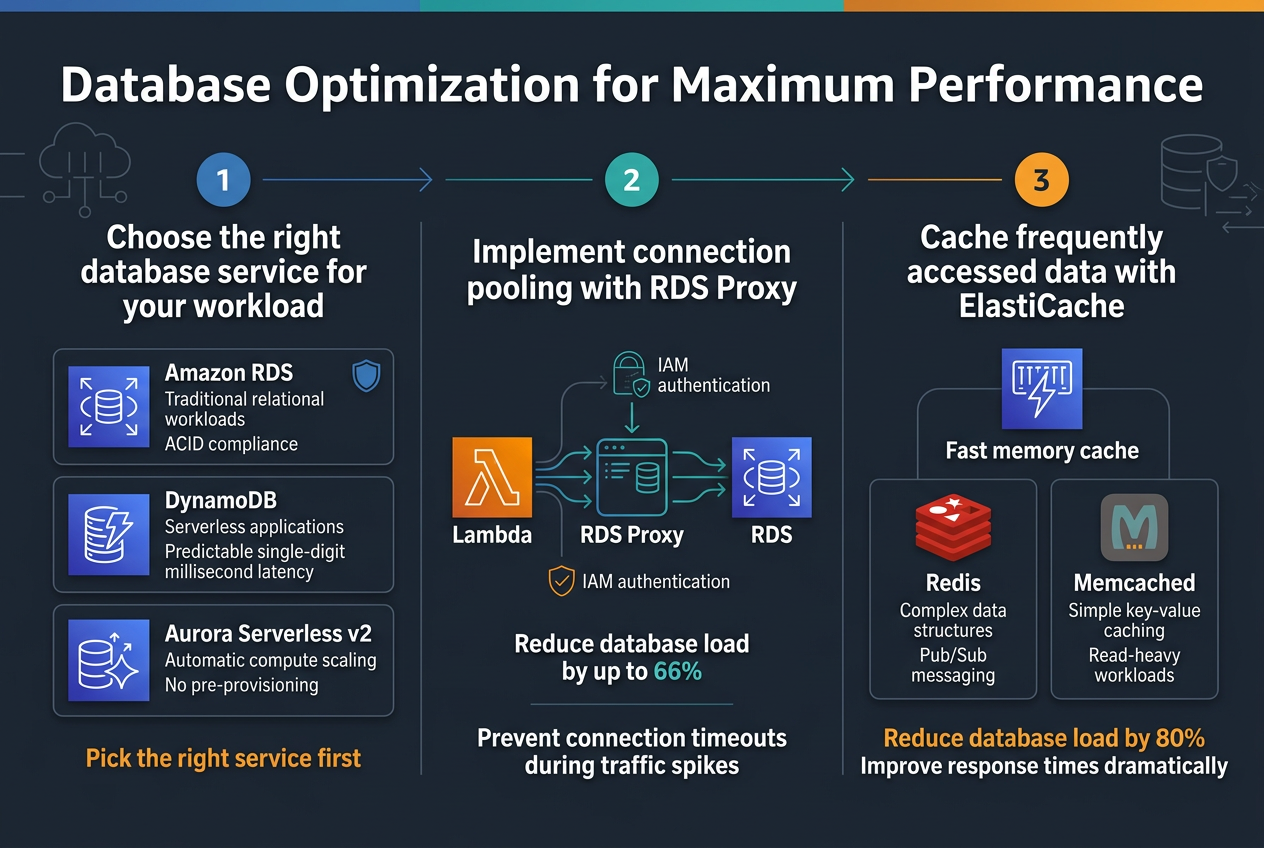
Choose the right database service for your workload
Picking the wrong database service can sink your AWS backend architecture before you even launch. Amazon RDS works perfectly for traditional relational workloads that need ACID compliance, while DynamoDB shines for serverless applications requiring predictable single-digit millisecond latency. Aurora Serverless v2 bridges both worlds, automatically scaling compute capacity based on actual demand without pre-provisioning resources.
Implement connection pooling with RDS Proxy
Database connections eat up resources faster than you’d expect. RDS Proxy sits between your Lambda functions and RDS instances, pooling connections efficiently and reducing database load by up to 66%. This serverless database optimization technique prevents connection timeouts during traffic spikes while maintaining security through IAM authentication integration.
Cache frequently accessed data with ElastiCache
ElastiCache transforms slow database queries into lightning-fast responses by storing frequently accessed data in memory. Redis clusters handle complex data structures and pub/sub messaging, while Memcached offers simple key-value caching for read-heavy workloads. Implementing cache-aside patterns with ElastiCache can reduce database load by 80% and improve response times dramatically.
Security and Monitoring Without Added Complexity
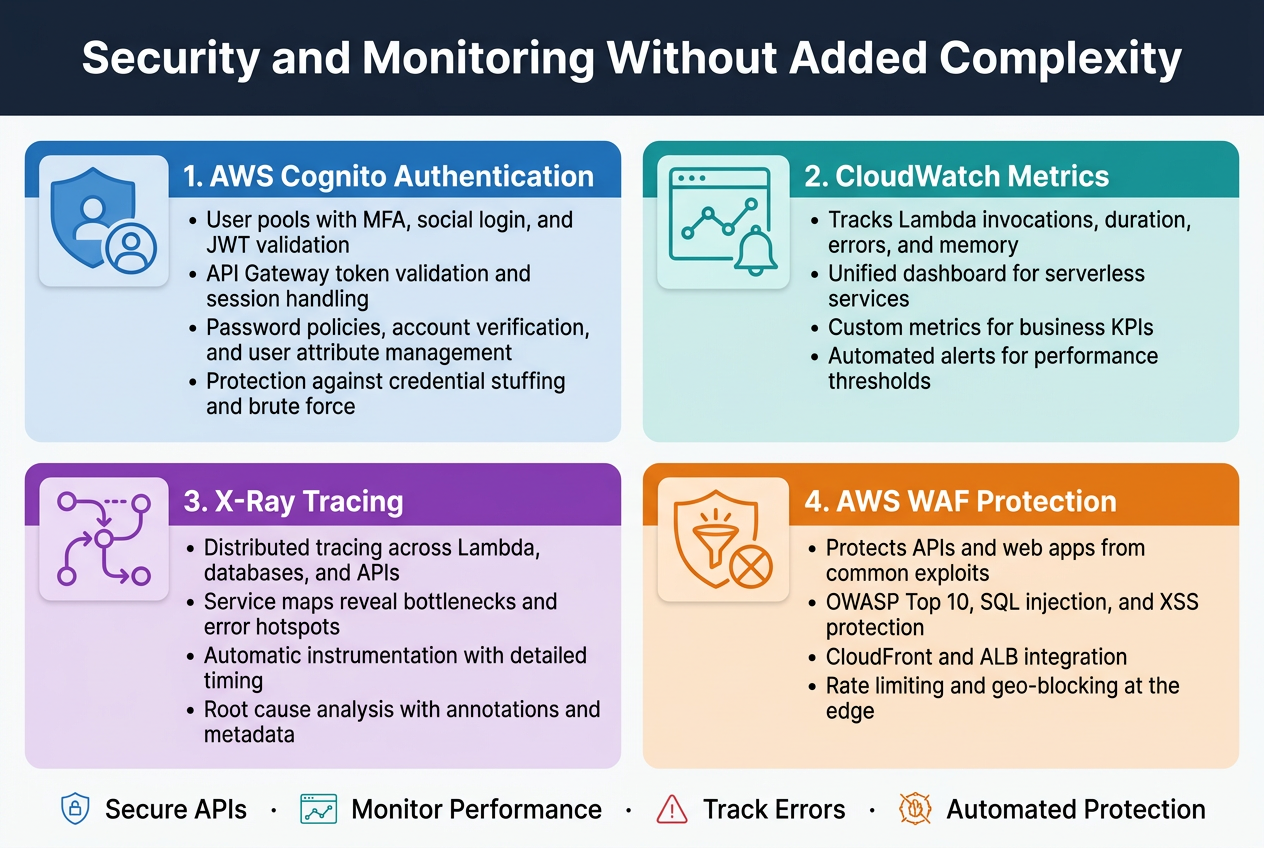
Secure APIs with AWS Cognito Authentication
AWS Cognito eliminates the complexity of building custom authentication systems while providing enterprise-grade security for your serverless architecture guide. Set up user pools with multi-factor authentication, social login integration, and JWT token validation in minutes rather than weeks. Cognito seamlessly integrates with API Gateway, automatically validating tokens and managing user sessions without writing authentication middleware.
The service handles password policies, account verification, and user attribute management through simple configuration. Your AWS backend architecture benefits from built-in protection against common attacks like credential stuffing and brute force attempts, while maintaining the scalability that serverless applications demand.
Monitor Performance with CloudWatch Metrics
CloudWatch automatically collects metrics from your AWS Lambda backend and other serverless services without requiring additional monitoring tools. Track invocation counts, duration, error rates, and memory usage across all your functions through a unified dashboard. Custom metrics let you monitor business-specific KPIs alongside infrastructure performance, giving you complete visibility into your application’s health.
Set up automated alerts that trigger when performance thresholds are exceeded, enabling proactive issue resolution. CloudWatch’s integration with other AWS services means you can correlate database performance, API Gateway latency, and Lambda execution times to identify bottlenecks quickly.
Track Errors and Bottlenecks Using X-Ray Tracing
X-Ray provides distributed tracing across your entire AWS backend architecture, showing exactly how requests flow through Lambda functions, databases, and external APIs. Visual service maps reveal performance bottlenecks and error hotspots that would otherwise require hours of log analysis to identify. The service automatically instruments AWS SDK calls and popular frameworks, capturing detailed timing information without code changes.
Root cause analysis becomes straightforward when you can see which specific service calls are failing or running slowly. X-Ray’s annotation and metadata features help you correlate business context with technical performance, making debugging faster and more accurate for complex event-driven architecture patterns.
Implement Automated Security with AWS WAF
AWS WAF protects your APIs and web applications from common web exploits without manual rule management. Pre-configured rule sets defend against OWASP Top 10 vulnerabilities, SQL injection, and cross-site scripting attacks automatically. The service integrates directly with CloudFront and Application Load Balancer, filtering malicious traffic before it reaches your backend services.
Rate limiting and geo-blocking features prevent abuse and reduce costs by blocking unwanted traffic at the edge. AWS WAF’s machine learning capabilities adapt to new attack patterns, providing evolving protection that improves over time without requiring security expertise from your development team.
Cost Optimization Strategies for Growing Applications
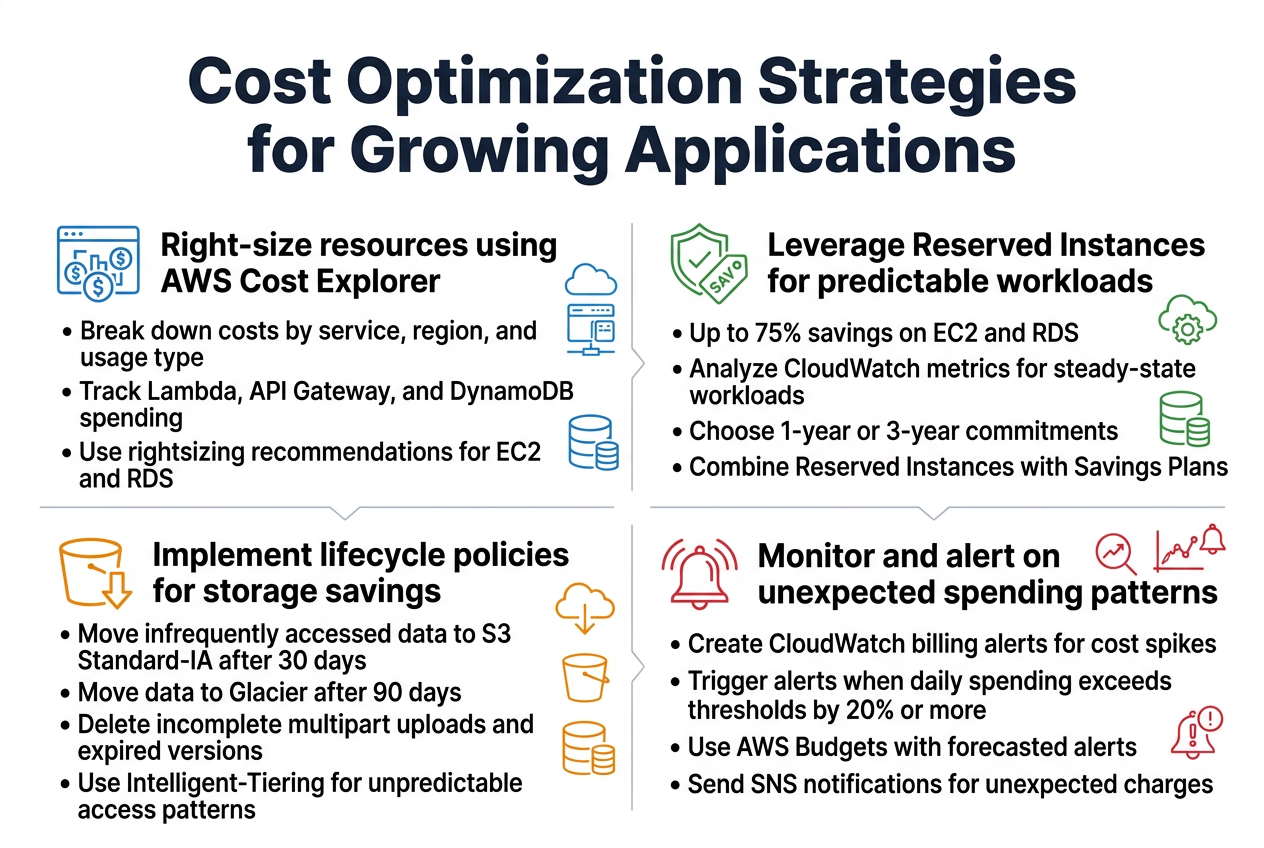
Right-size resources using AWS Cost Explorer
AWS Cost Explorer reveals spending patterns that guide smart resource allocation decisions. The platform breaks down costs by service, region, and usage type, showing exactly where money flows in your serverless architecture guide implementation. Set up custom reports to track Lambda execution costs, API Gateway requests, and DynamoDB consumption patterns. Use the rightsizing recommendations feature to identify oversized EC2 instances or underutilized RDS databases that drain your budget.
Leverage Reserved Instances for predictable workloads
Reserved Instances deliver up to 75% savings on EC2 and RDS costs when you commit to consistent usage patterns. Analyze your CloudWatch metrics to identify steady-state workloads running continuously for months. Purchase one-year terms for moderate savings or three-year commitments for maximum discounts. Combine Reserved Instances with Savings Plans for flexible coverage across multiple AWS services in your scalable backend design.
Implement lifecycle policies for storage savings
S3 lifecycle policies automatically transition objects between storage classes based on access patterns and age. Configure rules to move infrequently accessed data to S3 Standard-IA after 30 days, then to Glacier after 90 days for long-term archival. Delete incomplete multipart uploads and expired object versions to eliminate hidden storage costs. Set up intelligent tiering for unpredictable access patterns that optimize storage costs automatically.
Monitor and alert on unexpected spending patterns
CloudWatch billing alerts catch cost spikes before they damage your budget. Create custom metrics that trigger notifications when daily spending exceeds normal thresholds by 20% or more. Use AWS Budgets to set monthly limits with forecasted alerts that warn you three days before hitting budget caps. Configure SNS notifications to alert your team immediately when serverless functions generate unexpected charges from traffic spikes or infinite loops.
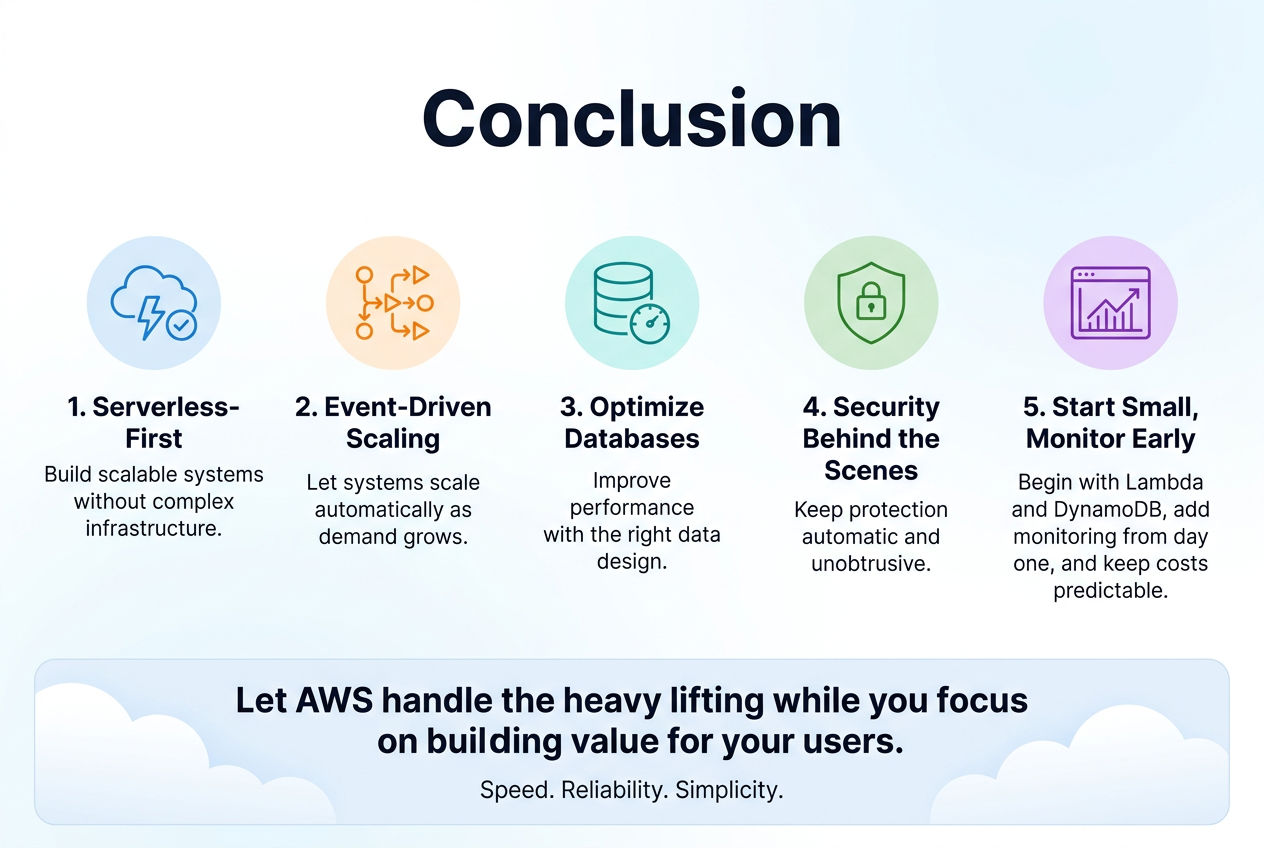
Building a scalable AWS backend doesn’t have to be a nightmare of complex configurations and endless maintenance. By embracing serverless-first principles and leveraging the right AWS services, you can create systems that grow with your business while keeping your team focused on what really matters – delivering value to your users. The key lies in choosing event-driven patterns that handle scaling automatically, optimizing your databases for real performance gains, and implementing security that works behind the scenes.
The real magic happens when you stop trying to manage every piece of infrastructure yourself. Let AWS handle the heavy lifting while you focus on building features that customers actually want. Start small with Lambda functions and DynamoDB, add monitoring from day one, and watch your costs stay predictable as you grow. Your future self will thank you for choosing simplicity over complexity, and your users will notice the difference in speed and reliability.
The post AWS Backend Architecture Guide: Build Less, Scale More first appeared on Business Compass LLC.
from Business Compass LLC https://ift.tt/8a0SnmB
via IFTTT


Comments
Post a Comment