Build a Real-Time News Aggregator Without Managing Servers
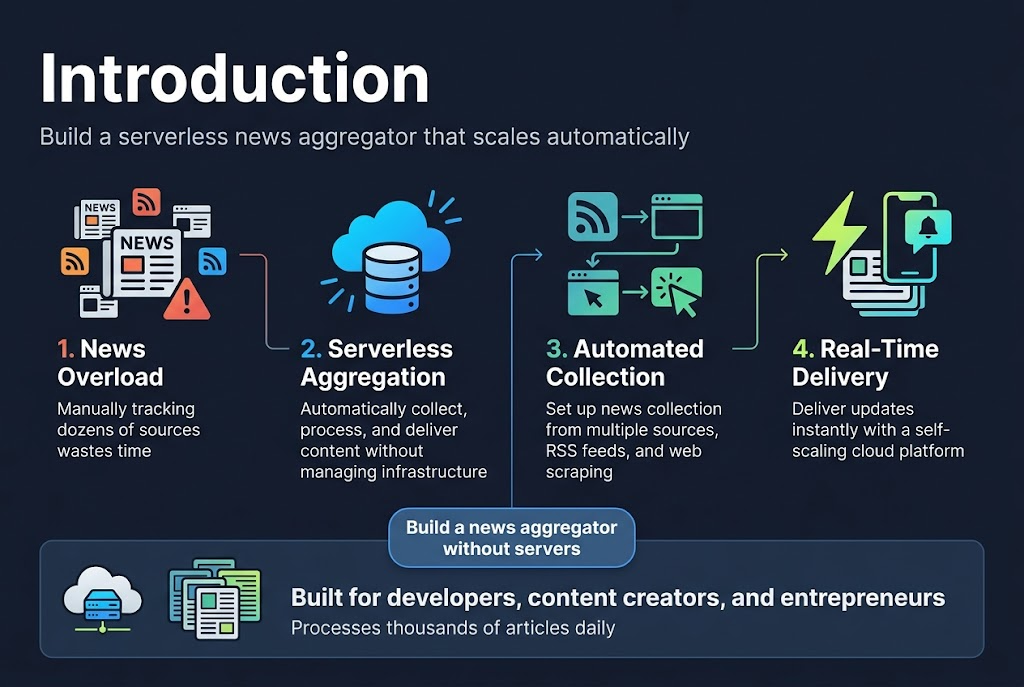
News overload is real, and manually tracking dozens of sources wastes valuable time. A serverless news aggregator solves this by automatically collecting, processing, and delivering content without the headache of managing infrastructure.
This guide is perfect for developers, content creators, and entrepreneurs who want to build a news aggregator without servers while keeping costs low and scalability high. You’ll learn to create a real-time news aggregation system that runs itself and scales automatically.
We’ll walk through selecting the best serverless data processing platform for your needs, setting up automated news collection from multiple sources, and building workflows that handle everything from RSS feeds to web scraping. You’ll also discover how to create efficient real-time news delivery systems that keep your audience informed instantly.
By the end, you’ll have a complete cloud news aggregation platform that processes thousands of articles daily without touching a single server configuration.
Choose the Right Serverless Platform for News Aggregation
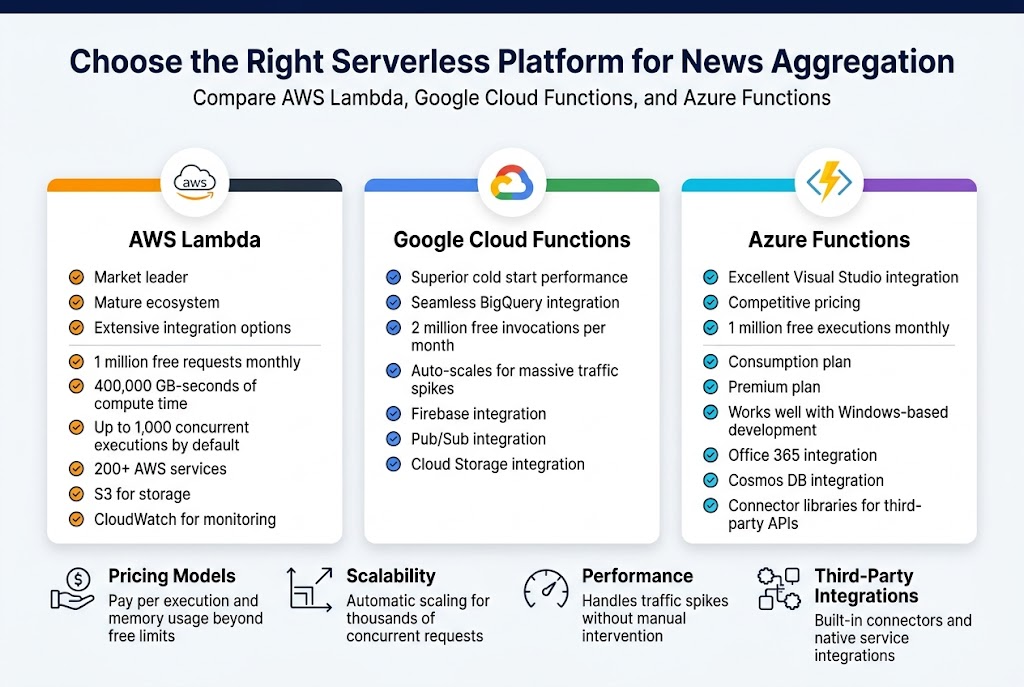
Compare AWS Lambda, Google Cloud Functions, and Azure Functions
AWS Lambda leads the serverless news aggregator market with its mature ecosystem and extensive integration options. Google Cloud Functions offers superior cold start performance and seamless BigQuery integration for news data analytics. Azure Functions provides excellent Visual Studio integration and competitive pricing for Windows-based development environments.
Evaluate pricing models and free tier benefits
AWS Lambda provides 1 million free requests monthly with 400,000 GB-seconds of compute time, making it ideal for small-scale news aggregation projects. Google Cloud Functions offers 2 million invocations per month free, while Azure Functions includes 1 million executions monthly. Each platform charges per execution and memory usage beyond free limits.
Assess scalability and performance capabilities
All three platforms automatically scale your serverless news aggregator based on incoming requests, handling thousands of concurrent news source processing without manual intervention. AWS Lambda supports up to 1,000 concurrent executions by default, while Google Cloud Functions can scale to handle massive traffic spikes. Azure Functions offers both consumption and premium plans for predictable performance requirements.
Review integration options with third-party services
AWS Lambda integrates seamlessly with over 200 AWS services including S3 for news storage and CloudWatch for monitoring your real-time news delivery system. Google Cloud Functions connects natively with Firebase, Pub/Sub, and Cloud Storage for automated news collection workflows. Azure Functions works well with Office 365, Cosmos DB, and third-party APIs through extensive connector libraries for building comprehensive news aggregation platforms.
Set Up Automated News Source Collection
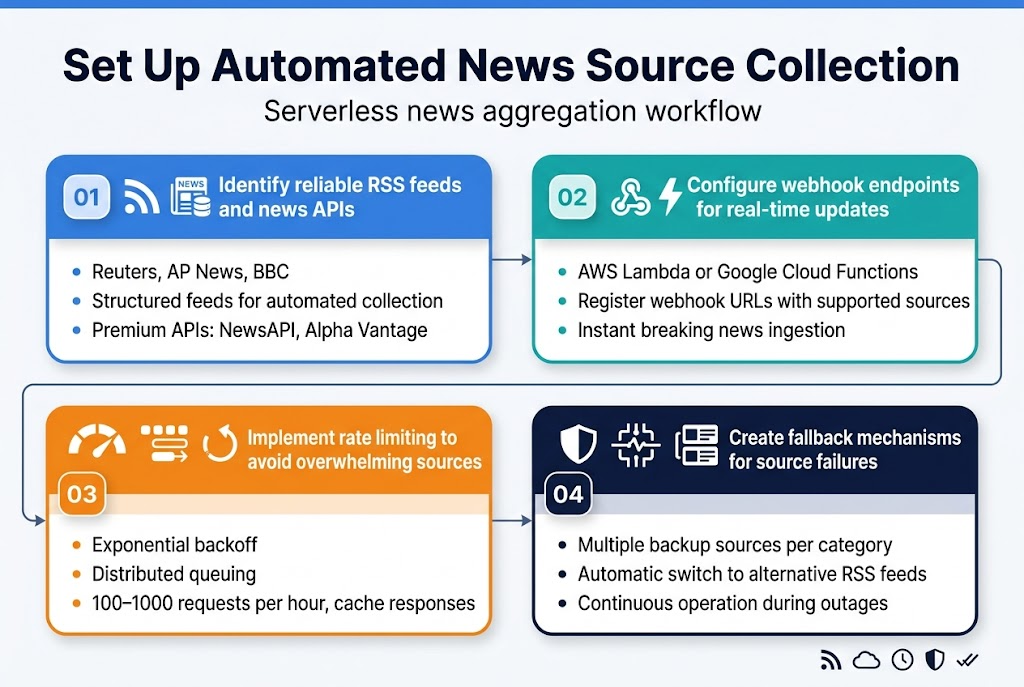
Identify reliable RSS feeds and news APIs
Building a robust serverless news aggregator starts with selecting dependable data sources. Focus on established news outlets that provide well-maintained RSS feeds and APIs with consistent uptime. Major publishers like Reuters, AP News, and BBC offer structured feeds perfect for automated collection. Premium APIs like NewsAPI or Alpha Vantage deliver clean, categorized content that reduces processing overhead.
Configure webhook endpoints for real-time updates
Real-time news delivery requires webhook integration for instant content updates. Set up serverless functions as webhook receivers using AWS Lambda or Google Cloud Functions to capture breaking news notifications. Configure your automated news collection system to register webhook URLs with news sources that support push notifications, enabling immediate data ingestion without constant polling.
Implement rate limiting to avoid overwhelming sources
Respect source limitations by implementing intelligent rate limiting across your serverless data processing pipeline. Use exponential backoff strategies and distributed queuing to prevent API throttling. Most news APIs have specific rate limits – typically 100-1000 requests per hour for free tiers. Configure your aggregator to spread requests evenly and cache responses to minimize redundant calls.
Create fallback mechanisms for source failures
Redundancy ensures continuous operation when primary sources fail. Design your news aggregator tutorial architecture with multiple backup sources for each content category. Implement circuit breakers that automatically switch to alternative RSS feeds when primary sources become unavailable, maintaining seamless real-time news aggregation even during outages.
Build Efficient Data Processing Workflows
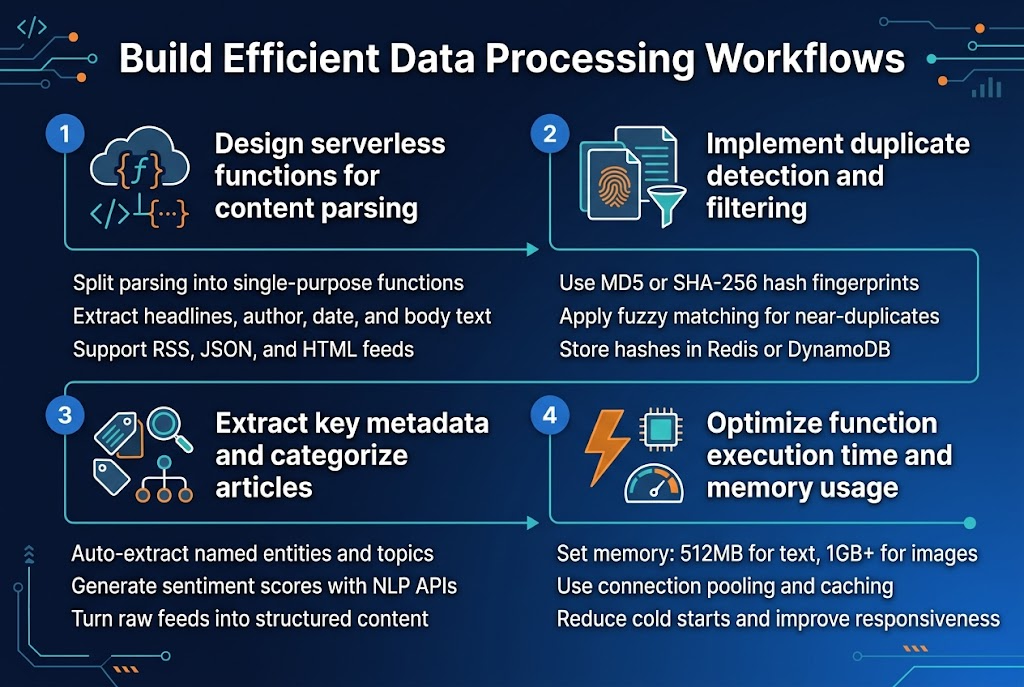
Design serverless functions for content parsing
Creating effective serverless data processing workflows requires breaking down news content parsing into focused, single-purpose functions. AWS Lambda, Google Cloud Functions, or Azure Functions can handle different parsing tasks like extracting headlines, author information, publication dates, and article body text from various feed formats including RSS, JSON, and HTML.
Implement duplicate detection and filtering
Duplicate content detection becomes critical when aggregating from multiple sources. Hash-based fingerprinting using MD5 or SHA-256 algorithms can quickly identify identical articles, while fuzzy matching techniques catch near-duplicates with slight variations. Store content hashes in a fast lookup database like Redis or DynamoDB to prevent processing the same story multiple times.
Extract key metadata and categorize articles
Smart metadata extraction transforms raw news feeds into structured, searchable content. Natural language processing APIs can automatically categorize articles by topic, extract named entities like people and organizations, and determine sentiment scores. This serverless news aggregator approach lets you build sophisticated classification without maintaining ML infrastructure.
Optimize function execution time and memory usage
Performance optimization directly impacts costs in serverless news scraping operations. Configure memory allocation based on actual usage patterns – text processing typically needs 512MB while image extraction requires 1GB or more. Implement connection pooling for database operations and cache frequently accessed data to reduce cold start penalties and improve your real-time news delivery system responsiveness.
Store and Manage News Data Cost-Effectively
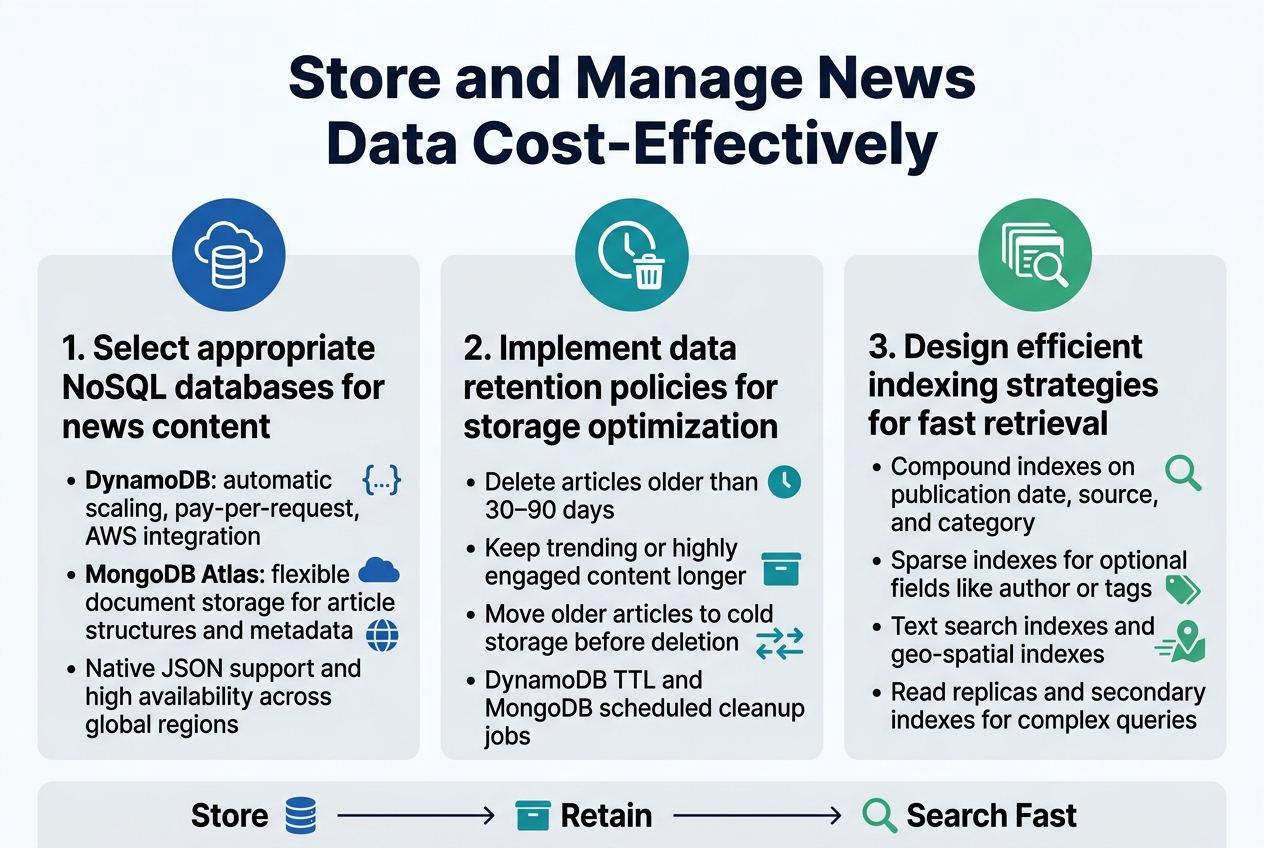
Select appropriate NoSQL databases for news content
DynamoDB and MongoDB Atlas shine for serverless news aggregator projects because they scale automatically without manual intervention. DynamoDB offers seamless AWS integration with pay-per-request pricing, making it perfect for variable news traffic patterns. MongoDB Atlas provides flexible document storage ideal for varying news article structures and metadata. Both databases handle JSON natively, simplifying your serverless data processing workflows while maintaining high availability across global regions.
Implement data retention policies for storage optimization
Smart retention policies keep storage costs low while maintaining relevant content. Set up automated deletion for articles older than 30-90 days based on your audience needs, keeping only trending or highly-engaged content longer. Configure tiered storage moving older articles to cheaper cold storage before deletion. DynamoDB’s TTL feature automatically removes expired items, while MongoDB’s scheduled jobs handle cleanup tasks without additional infrastructure management.
Design efficient indexing strategies for fast retrieval
Create compound indexes on frequently queried fields like publication date, source, and category for lightning-fast searches. Use sparse indexes on optional fields like author or tags to optimize storage space. Implement text search indexes for full-text article searches and geo-spatial indexes if location-based news filtering matters. Consider read replicas or secondary indexes for complex queries, ensuring your real-time news delivery system responds quickly even during traffic spikes.
Create Real-Time Delivery Mechanisms
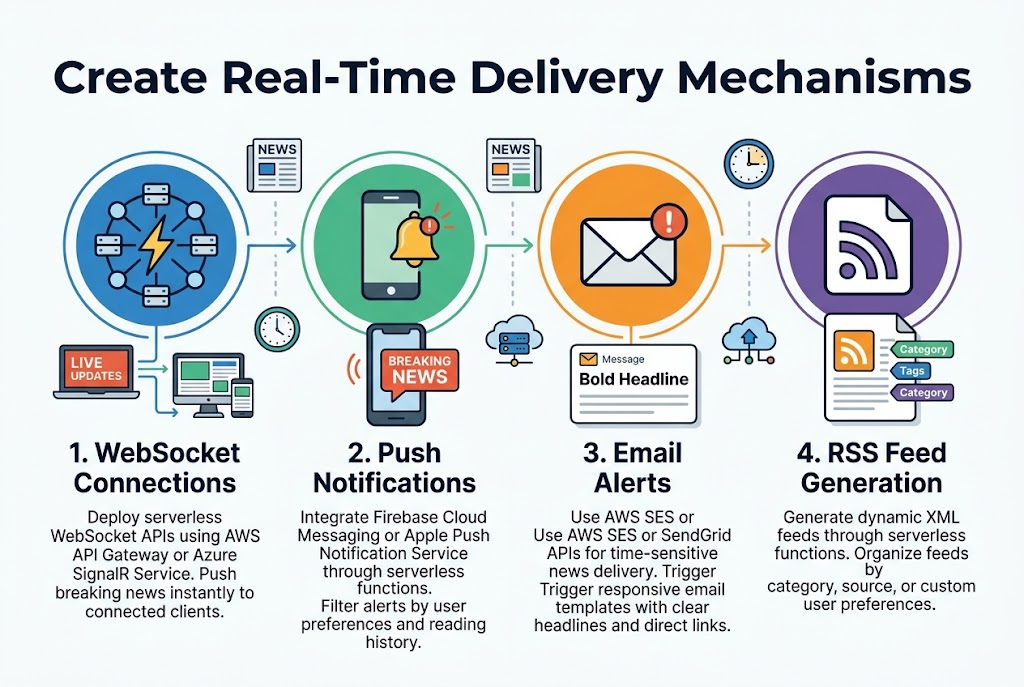
Set up WebSocket connections for instant updates
WebSocket connections form the backbone of any real-time news delivery system. Deploy serverless WebSocket APIs using AWS API Gateway or Azure SignalR Service to push news updates instantly to connected clients. These persistent connections eliminate polling overhead and deliver breaking news within milliseconds, creating a responsive user experience that keeps readers engaged with your serverless news aggregator.
Implement push notifications for mobile users
Push notifications extend your real-time news delivery beyond active browsing sessions. Integrate Firebase Cloud Messaging or Apple Push Notification Service through serverless functions to send breaking news alerts directly to users’ devices. Configure smart filtering based on user preferences and reading history to avoid notification fatigue while ensuring critical updates reach subscribers immediately.
Configure email alerts for breaking news
Email alerts provide reliable backup delivery for time-sensitive news when users aren’t actively using your platform. Set up serverless email workflows using AWS SES or SendGrid APIs, triggered by specific news categories or keywords. Design responsive email templates with clear headlines and direct links back to your aggregator, maintaining engagement across multiple touchpoints.
Build RSS feed generation for subscribers
RSS feeds enable seamless integration with existing news readers and automated content distribution. Generate dynamic XML feeds through serverless functions that update automatically as new articles arrive. Structure feeds by category, source, or custom user preferences, ensuring your serverless RSS feed aggregator remains compatible with popular feed readers while supporting personalized content delivery.
Monitor Performance and Troubleshoot Issues
Track function execution metrics and error rates
Monitoring your serverless news aggregator performance starts with tracking key metrics like function invocation counts, execution duration, and memory usage. AWS CloudWatch automatically captures these metrics for Lambda functions, while Azure Monitor provides similar insights for Functions. Set up custom dashboards that display error rates, timeout occurrences, and cold start frequencies to identify bottlenecks in your news processing pipeline.
Set up automated alerts for system failures
- Configure threshold-based alerts for error rates exceeding 5%
- Monitor RSS feed parsing failures and API rate limit breaches
- Set up notifications for database connection timeouts
- Create alerts for unusually high function execution costs
- Implement dead letter queue monitoring for failed news processing tasks
Implement logging strategies for debugging
Structured logging helps troubleshoot issues in your serverless news aggregation workflows. Use JSON format for logs and include correlation IDs to trace requests across multiple functions. Log critical events like successful news article extractions, failed API calls, and data transformation errors. Centralized logging services like AWS CloudTrail or Azure Application Insights make debugging distributed news processing workflows much easier.
Optimize costs through usage analysis
- Analyze function execution patterns to right-size memory allocations
- Identify unused or redundant news sources consuming resources
- Review storage costs for news data retention policies
- Monitor API gateway requests and optimize caching strategies
- Use cost allocation tags to track expenses by news source or feature
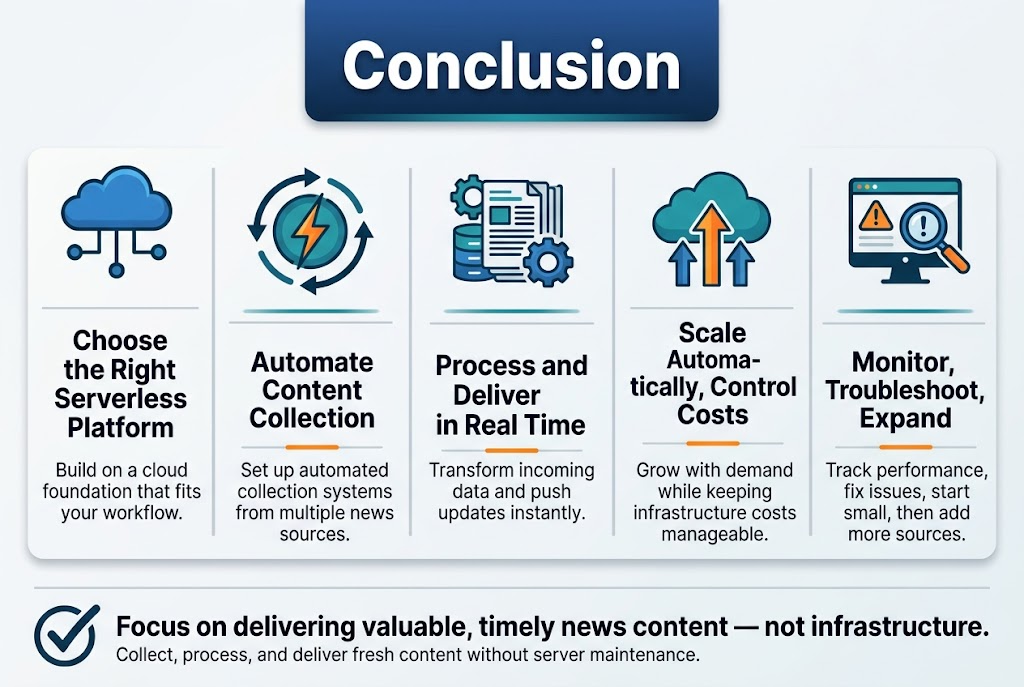
Building a serverless news aggregator gives you the power to create a dynamic platform that collects, processes, and delivers fresh content without the headache of server maintenance. From selecting the right serverless platform to setting up automated collection systems, you now have a roadmap for creating efficient workflows that handle everything from data processing to real-time delivery. The beauty lies in how these cloud-based solutions automatically scale with your needs while keeping costs manageable.
Your news aggregator can now pull content from multiple sources, process it smartly, and push updates to users instantly. Remember to keep monitoring your system’s performance and stay ready to troubleshoot any hiccups along the way. Start with one or two news sources, get your basic workflow running smoothly, then gradually expand your reach. The serverless approach means you can focus on what matters most – delivering valuable, timely news content to your audience rather than wrestling with infrastructure.
The post Build a Real-Time News Aggregator Without Managing Servers first appeared on Business Compass LLC.
from Business Compass LLC https://ift.tt/QOH2yeh
via IFTTT


Comments
Post a Comment