Understanding Application Architecture: Monolith vs Serverless
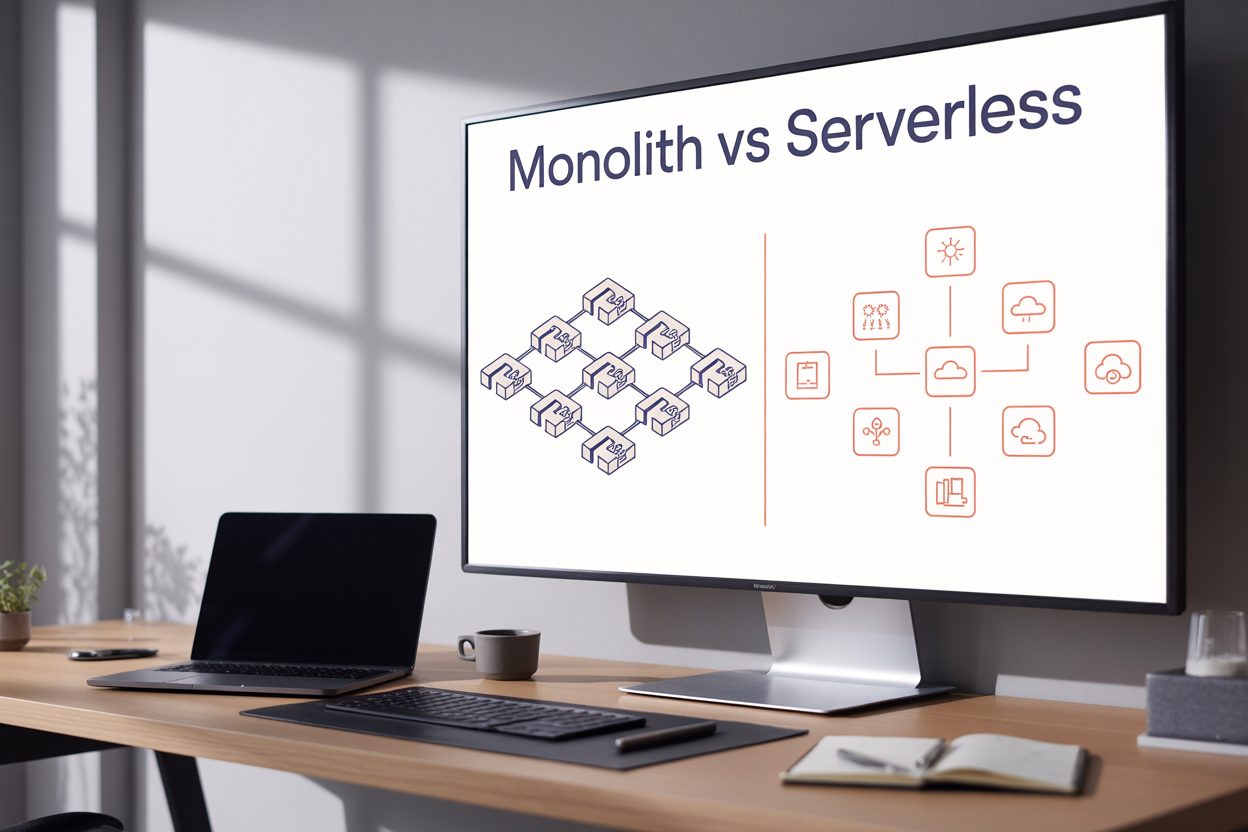
Choosing the right application architecture can make or break your software project. This guide breaks down the monolith vs serverless debate for software developers, tech leads, and engineering teams who need to make informed architecture decisions.
You’ll discover the core differences between monolithic architecture and serverless architecture, including how each approach handles scalability and performance under real-world conditions. We’ll also dive into the practical aspects of development experience and team productivity, showing you how each architecture pattern affects your day-to-day coding workflow. Finally, you’ll get a clear framework for choosing between serverless computing and traditional monolithic approaches based on your specific project requirements.
By the end, you’ll have the knowledge to confidently select the software architecture pattern that best fits your application’s needs, timeline, and budget.
Core Components and Structure of Monolithic Architecture

Single Deployable Unit Benefits for Development Teams
Monolithic architecture operates as one cohesive unit where all components, features, and services bundle together into a single application package. This unified approach brings significant advantages for development teams, especially those working on new projects or maintaining smaller applications.
When teams deploy monolithic applications, they handle everything at once – frontend, backend, database connections, and business logic all ship together. This simplicity eliminates the complexity of coordinating multiple deployments across different services. Developers can focus on building features rather than managing deployment pipelines for dozens of microservices.
The debugging process becomes more straightforward since everything runs in the same process space. When an error occurs, developers can trace the entire request flow through their application without jumping between multiple services or dealing with distributed tracing complexities. Code changes get tested as a complete unit, reducing integration surprises.
Team collaboration benefits from this shared codebase approach. New team members can understand the entire application architecture by exploring a single repository. Knowledge sharing happens naturally when everyone works within the same codebase boundaries, and code reviews cover the full context of changes.
Shared Database and Memory Management Advantages
Monolithic architecture typically connects to a single database instance, creating powerful opportunities for data consistency and transaction management. ACID transactions work seamlessly across the entire application since all operations happen within the same database context. This eliminates the distributed transaction complexities that plague serverless and microservices architectures.
Memory management becomes highly efficient in monolithic applications. Objects and data structures can be shared across different modules without serialization overhead. Caching strategies work more effectively since the entire application shares the same memory space. Connection pooling to databases gets optimized at the application level rather than being distributed across multiple services.
Data relationships remain simple and performant. Join operations across tables happen within the same database without network calls between services. Complex queries that span multiple business domains can execute efficiently, something that becomes challenging when data splits across multiple services in distributed architectures.
The single database model also simplifies backup and recovery procedures. Database administrators manage one system instead of coordinating backups across multiple database instances. Schema changes roll out consistently across the entire application, avoiding version compatibility issues between services.
Centralized Logging and Monitoring Capabilities
Monitoring monolithic applications provides a clear, unified view of system health and performance. All application logs flow through the same logging framework, making it easier to correlate events and trace user requests from start to finish. Performance metrics aggregate naturally since everything runs within the same process boundaries.
Error tracking becomes more straightforward when all components report to the same monitoring system. Stack traces remain complete and meaningful since they don’t cross service boundaries. Application performance monitoring tools can provide comprehensive insights into bottlenecks without dealing with distributed tracing overhead.
Resource monitoring focuses on a single deployment unit. Server metrics like CPU usage, memory consumption, and disk I/O directly correlate to application performance. This direct relationship makes capacity planning and performance optimization more predictable compared to serverless computing where resources are abstracted away.
Centralized logging also supports better security auditing. All user actions and system events get recorded in a consistent format within the same logging infrastructure. Compliance requirements become easier to meet when audit trails don’t span multiple systems or require complex aggregation across distributed services.
Essential Elements of Serverless Architecture

Event-Driven Function Execution Model
Serverless architecture operates on a fundamentally different execution model compared to traditional monolithic applications. Instead of running continuously, serverless functions activate only when specific events trigger them – whether that’s an HTTP request, a database change, or a file upload. This event-driven approach means your code literally sleeps until something needs to happen.
Functions in serverless computing are stateless and ephemeral. Each function execution starts fresh, processes the incoming event, and then terminates. This creates a clean separation between different pieces of functionality, making your application architecture more modular and easier to debug. When a user uploads an image, for example, one function might handle the upload while another processes the image resizing, and yet another updates the database record.
The beauty of this model lies in its simplicity. Developers write small, focused functions that do one thing well. These functions can be triggered by dozens of different event sources – API gateways, message queues, scheduled events, or changes in cloud storage. This flexibility allows you to build complex workflows by chaining together simple functions, creating a more responsive and adaptable system than traditional application architecture patterns.
Automatic Scaling and Resource Management
One of the most compelling aspects of serverless computing is how it handles scaling without any intervention from your development team. The cloud provider automatically spins up new function instances when demand increases and scales them down when traffic drops. This happens in milliseconds, not the minutes or hours required for traditional server scaling.
Your functions can scale from zero to thousands of concurrent executions seamlessly. If your application suddenly goes viral and receives 10,000 simultaneous requests, the serverless platform creates 10,000 function instances to handle the load. When the traffic dies down, those instances disappear, and you stop paying for them immediately.
This automatic resource management extends beyond just compute power. Memory allocation, CPU resources, and even network capacity adjust dynamically based on your function’s requirements. You don’t need to provision servers, configure load balancers, or worry about capacity planning. The serverless platform handles all these infrastructure concerns, letting your team focus entirely on writing business logic.
The scaling happens at the individual function level too. If your image processing function needs more resources than your user authentication function, each scales independently based on its specific workload and performance requirements.
Pay-Per-Use Cost Structure Benefits
Serverless architecture completely transforms how you think about application costs. Instead of paying for servers that run 24/7 regardless of usage, you only pay for the exact compute time your functions actually use. This granular billing model can result in dramatic cost savings, especially for applications with variable or unpredictable traffic patterns.
The pricing typically works on millisecond-level granularity. If your function executes for 200 milliseconds, you pay for 200 milliseconds of compute time. No more paying for idle servers during off-peak hours or weekends when your application sits mostly unused. This makes serverless computing particularly attractive for startups and small businesses that need to optimize every dollar.
For applications with sporadic usage patterns – like internal tools, batch processing jobs, or seasonal applications – the cost benefits become even more pronounced. A function that runs once per hour for 30 seconds costs virtually nothing compared to maintaining a dedicated server. Even high-traffic applications can see significant savings because the automatic scaling means you’re never over-provisioned during low-traffic periods.
Many cloud providers also offer generous free tiers for serverless functions, allowing small applications to run at zero cost. This democratizes access to powerful computing resources and enables developers to experiment and prototype without worrying about infrastructure expenses.
Cloud Provider Infrastructure Dependencies
While serverless computing offers tremendous benefits, it also creates a deeper relationship with your chosen cloud provider’s infrastructure. Your application becomes tightly coupled to specific services, APIs, and architectural patterns that may not easily transfer to other platforms. This vendor lock-in represents one of the most significant considerations when choosing serverless architecture.
Each cloud provider implements serverless computing differently. AWS Lambda has different limits, pricing models, and integration patterns compared to Google Cloud Functions or Azure Functions. The event sources, monitoring tools, and deployment mechanisms vary significantly between platforms. Moving a complex serverless application from one provider to another often requires substantial refactoring.
Cloud provider dependencies extend beyond just the function runtime. Serverless applications typically rely heavily on other managed services – databases, message queues, API gateways, and storage systems – that are deeply integrated with the serverless platform. This creates a web of dependencies that can make migration challenging and potentially expensive.
However, these dependencies also bring advantages. Deep integration with cloud services means better performance, more reliable connections, and access to enterprise-grade infrastructure without the complexity of managing it yourself. The key is understanding these trade-offs upfront and making conscious decisions about which dependencies align with your long-term technical strategy.
Development Experience and Team Productivity Comparison

Faster Initial Development with Monolithic Approach
Monolithic architecture offers significant advantages when starting new projects. Development teams can rapidly prototype and build features since everything lives in a single codebase. Developers work with familiar tools and patterns, making it easy to understand the entire application flow from database to user interface.
Setting up a monolithic application requires minimal infrastructure complexity. Teams deploy one application to one server, eliminating the need for complex orchestration tools or distributed system management. This simplicity translates to faster time-to-market for startups and projects with tight deadlines.
Database transactions remain straightforward in monolithic systems. When business logic spans multiple data entities, developers can rely on traditional ACID properties without worrying about distributed transaction coordination. This makes implementing complex business rules much more predictable and reliable.
Independent Function Development in Serverless
Serverless architecture shines when teams need to work on different features simultaneously. Each function operates independently, allowing developers to build, test, and deploy specific functionality without affecting other parts of the system. This isolation reduces merge conflicts and enables parallel development workflows.
Teams can choose different programming languages and frameworks for individual functions based on specific requirements. A data processing function might use Python for its rich scientific libraries, while a real-time API could leverage Node.js for its performance characteristics. This flexibility lets teams optimize each component for its intended purpose.
Function-based development also supports specialized team structures. Backend developers can focus on data processing functions while frontend specialists handle user-facing APIs. Each team member can work within their expertise area without needing deep knowledge of the entire application architecture.
Testing and Debugging Complexity Differences
Monolithic applications provide straightforward testing environments. Developers can run the entire application locally, making it easy to reproduce bugs and test feature interactions. Integration testing happens naturally since all components run together in the same process.
Debugging monolithic systems follows traditional approaches. Developers can set breakpoints, step through code, and trace execution paths using familiar development tools. Stack traces provide clear visibility into error locations and call hierarchies.
Serverless architecture presents unique testing challenges. Each function needs individual testing, but the real complexity emerges when testing function interactions. Local development environments struggle to replicate cloud provider services accurately, often requiring specialized tools or cloud-based testing environments.
Debugging serverless applications requires new approaches. Cloud provider logs become the primary debugging tool, but distributed tracing across multiple functions can be challenging. Cold start issues and timeout behaviors are difficult to reproduce in local environments, making production debugging skills essential.
Code Organization and Maintainability Factors
Monolithic codebases benefit from consistent coding standards and shared libraries across the entire application. Teams can establish clear architectural patterns that apply throughout the system, making it easier for developers to understand and modify unfamiliar code sections.
Code reuse happens naturally in monolithic systems. Common utilities, validation logic, and business rules can be shared across different application modules without additional deployment complexity. This reduces duplication and ensures consistent behavior across features.
Serverless architecture forces better separation of concerns by design. Each function has a single responsibility, making individual components easier to understand and modify. This granular approach can lead to cleaner, more focused code that’s easier to reason about.
However, serverless systems can suffer from code duplication across functions. Common logic might get copied between functions to avoid complex dependency management, leading to maintenance challenges when business rules change. Teams need strong discipline to manage shared code through packages or layers while maintaining deployment independence.
Scalability and Performance Trade-offs

Vertical Scaling Limitations in Monolithic Systems
Monolithic architecture faces significant scalability challenges when your application needs to handle increasing traffic loads. Since the entire application runs as a single unit, scaling means replicating the whole system even when only specific components need more resources. Picture a restaurant where you’d have to hire an entire kitchen staff just because you need one extra pizza chef – that’s essentially how monolithic architecture approaches scaling.
Vertical scaling in monolithic systems typically requires upgrading hardware resources like CPU, memory, or storage for the entire application. This approach hits a ceiling quickly because there’s only so much you can beef up a single server before costs become prohibitive. You’re also creating a single point of failure where one overloaded component can bring down the entire system.
Resource allocation becomes inefficient since different parts of your application have varying demands. Your user authentication module might need minimal resources while your data processing component requires heavy computational power. With monolithic architecture, you can’t optimize for these individual needs – everything gets the same resource allocation whether it needs it or not.
Database connections present another bottleneck. The entire monolith typically shares connection pools, meaning one poorly performing query can affect the entire application’s performance. This creates cascading effects where problems in one area quickly spread throughout the system.
Instant Auto-Scaling Advantages of Serverless Functions
Serverless computing transforms the scalability game by handling individual functions independently. Each function scales automatically based on incoming requests without requiring manual intervention or capacity planning. When traffic spikes hit your application, serverless platforms like AWS Lambda or Azure Functions spin up additional instances within milliseconds to handle the load.
The granular nature of serverless architecture means you only scale what actually needs scaling. If your image processing function suddenly receives 10,000 requests while your user login function remains quiet, only the image processing component scales up. This targeted approach optimizes both performance and costs since you’re not wasting resources on idle components.
Auto-scaling happens transparently in the background. The cloud provider monitors execution metrics and automatically adjusts capacity based on real-time demand. This eliminates the guesswork involved in traditional capacity planning where you’d need to predict traffic patterns and provision resources accordingly.
Serverless functions can handle massive concurrent executions right out of the box. AWS Lambda, for example, can run thousands of function instances simultaneously without any configuration changes on your part. This level of instant scalability would require extensive infrastructure planning and significant upfront investment in traditional monolithic deployments.
The pay-per-execution model aligns costs directly with usage, making serverless particularly attractive for applications with unpredictable or seasonal traffic patterns. You’re not paying for idle server time during low-traffic periods, yet you get unlimited scaling capacity when demand surges.
Cold Start Performance Impact on User Experience
Cold starts represent one of serverless architecture’s most significant performance trade-offs. When a function hasn’t been invoked recently, the cloud provider needs time to initialize the runtime environment, load your code, and establish necessary connections. This initialization period, known as a cold start, can add anywhere from 100 milliseconds to several seconds of latency to your first request.
The severity of cold start delays varies significantly based on the programming language and runtime complexity. Node.js and Python functions typically experience shorter cold starts compared to Java or .NET applications, which require more time for runtime initialization. Functions with heavy dependencies or large deployment packages face longer cold start periods since more code needs loading into memory.
Cold starts particularly impact user-facing applications where response time directly affects user experience. A 2-second delay during login or checkout processes can lead to user abandonment and lost revenue. For real-time applications like chat systems or gaming backends, cold start latency can make serverless architecture unsuitable without proper mitigation strategies.
Various techniques help minimize cold start impact on application architecture. Keeping functions “warm” through scheduled pings, optimizing deployment package sizes, and using provisioned concurrency are common approaches. Some developers implement hybrid architectures where performance-critical functions run on traditional servers while less frequent operations leverage serverless benefits.
The cold start penalty affects different use cases differently. Batch processing jobs that run for minutes or hours see negligible impact from initial cold start delays. However, APIs serving mobile applications or web frontends need careful consideration of cold start frequency and mitigation strategies to maintain acceptable performance standards.
Understanding cold start patterns helps in making informed architectural decisions. Functions that receive regular traffic rarely experience cold starts, while infrequently used functions may face cold starts on every invocation. This knowledge shapes how you structure your serverless vs traditional architecture choices for optimal user experience.
Cost Analysis and Resource Optimization

Predictable Infrastructure Costs with Monoliths
Monolithic architecture brings the comfort of knowing exactly what you’ll spend each month. When you deploy your entire application on dedicated servers or cloud instances, the pricing stays consistent regardless of usage spikes or quiet periods. You pay the same $500 monthly server cost whether your app serves 1,000 users or 10,000 users.
This predictability makes budgeting straightforward. Finance teams love the certainty – no surprise bills at month-end, no complex calculations based on function invocations. You can plan infrastructure costs years ahead with reasonable accuracy. Traditional hosting providers offer volume discounts for longer commitments, making monolithic architecture particularly cost-effective for established businesses with steady traffic patterns.
However, this stability comes with a catch. You’re essentially paying for peak capacity 24/7, even during low-traffic periods. That powerful server handling Black Friday traffic sits mostly idle on quiet Tuesday afternoons, yet the bill remains the same. For applications with predictable, consistent load, this inefficiency might be acceptable given the operational simplicity.
Variable Serverless Pricing Based on Usage
Serverless computing flips the cost model completely. You pay only when your code executes, measured in milliseconds of compute time and memory consumption. AWS Lambda charges per request and execution duration, while services like Vercel bill based on function invocations and edge bandwidth usage.
This pay-per-use model can dramatically reduce costs for applications with sporadic traffic. A blog that receives 1,000 monthly visitors might run on serverless for under $10, compared to hundreds for dedicated hosting. The automatic scaling means you don’t waste money on idle resources during quiet periods.
Yet serverless pricing complexity can catch teams off-guard. Multiple billing dimensions – function duration, memory allocation, API gateway requests, data transfer, storage operations – create intricate cost calculations. A poorly optimized function running longer than necessary can generate unexpected expenses. Cold start penalties might push execution times higher, increasing costs without improving performance.
Hidden Costs and Vendor Lock-in Considerations
Beyond obvious infrastructure expenses, both architectures carry hidden costs that significantly impact total cost of ownership. Monolithic applications require ongoing maintenance overhead – security patches, operating system updates, monitoring tools, and backup solutions. These operational tasks demand dedicated engineering time or managed service fees.
Serverless architecture introduces different hidden costs. Vendor lock-in becomes a genuine concern when your application deeply integrates with provider-specific services. Migrating from AWS Lambda to Azure Functions isn’t just about moving code – you’ll need to rewrite integrations with databases, messaging queues, and authentication systems. This dependency creates switching costs that can trap teams with unsuitable providers.
Development tooling costs also differ between approaches. Monolithic applications often require expensive monitoring solutions, load balancers, and deployment pipelines. Serverless development might need specialized debugging tools, local development environments that simulate cloud behavior, and third-party services for observability across distributed functions.
Long-term Financial Planning Strategies
Smart financial planning requires understanding how each architecture impacts costs as your application grows. Monolithic architecture costs scale in predictable steps – you add servers as load increases, creating a staircase cost pattern. This makes capacity planning straightforward but potentially wasteful during transition periods.
For monolithic applications, negotiate multi-year hosting contracts with growth clauses. Reserve instances on cloud platforms offer significant discounts for committed usage. Consider hybrid approaches where you maintain baseline capacity on dedicated infrastructure while handling traffic spikes through auto-scaling groups.
Serverless cost optimization requires different strategies. Monitor function execution patterns to identify optimization opportunities. Memory-optimized functions might complete faster despite higher per-millisecond costs. Implement intelligent caching to reduce function invocations. Consider keeping frequently-accessed functions warm to avoid cold start penalties.
Budget for both architectures with scenario planning. Model costs under different growth trajectories, traffic patterns, and feature complexity. Monolithic architecture often shows lower initial costs but steeper scaling curves. Serverless might start cheaper but become expensive at high scale without careful optimization.
Regular cost audits become essential regardless of architecture choice. Track metrics like cost-per-user, cost-per-transaction, and infrastructure-to-revenue ratios to make informed scaling decisions.
Choosing the Right Architecture for Your Project

Team Size and Expertise Requirements
Small teams with full-stack developers often thrive with monolithic architecture because everyone can work across the entire codebase. When you have 2-5 developers, maintaining a single deployable unit makes perfect sense. Your team can ship features faster without coordinating between multiple services, and debugging becomes straightforward since everything runs in one place.
Serverless architecture demands a different skill set. Your developers need deep understanding of cloud services, event-driven programming, and distributed systems. If your team lacks experience with AWS Lambda, API Gateway, or similar platforms, the learning curve can slow down initial development significantly. You’ll also need someone comfortable with infrastructure-as-code tools like Terraform or CloudFormation.
Larger organizations with specialized teams benefit more from serverless approaches. When you have dedicated DevOps engineers, cloud architects, and multiple development teams, the distributed nature of serverless functions allows teams to work independently. Each team can own specific functions without stepping on each other’s toes.
Consider your hiring capabilities too. Finding developers experienced in serverless computing costs more than traditional full-stack developers. If budget constraints limit your hiring options, starting with monolithic architecture might be more practical.
Application Complexity and Traffic Patterns
Simple applications with predictable traffic patterns work well as monoliths. If you’re building a standard CRUD application, content management system, or basic e-commerce site, monolithic architecture provides all the functionality you need without unnecessary complexity.
Serverless architecture shines with applications that have highly variable traffic or event-driven workflows. Think about applications that process file uploads, handle webhook events, or respond to user-generated content. These scenarios naturally fit the serverless model where functions scale automatically based on demand.
Complex applications with distinct business domains benefit from serverless decomposition. When your application handles user authentication, payment processing, inventory management, and reporting, separating these concerns into individual functions improves maintainability and allows independent scaling.
Traffic patterns significantly impact your architecture choice. Applications with steady, predictable load favor monoliths because you can optimize resource usage and reduce cold start overhead. Conversely, applications with sporadic traffic spikes or unpredictable usage patterns leverage serverless auto-scaling capabilities effectively.
Business Goals and Time-to-Market Priorities
Rapid prototyping and MVP development often favor monolithic architecture. When you need to validate a business idea quickly, building everything in one codebase lets you iterate faster. You can change database schemas, modify business logic, and refactor components without worrying about service boundaries or API contracts.
Established businesses with long-term scalability goals should consider serverless architecture. The initial investment in learning and setup pays dividends when your application needs to handle millions of users. Serverless computing provides automatic scaling, reduced operational overhead, and pay-per-use pricing that grows with your business.
Budget-conscious startups appreciate the cost model differences. Monoliths require consistent server costs regardless of usage, while serverless functions only charge for actual execution time. If your application has low initial traffic, serverless can significantly reduce infrastructure costs.
Companies planning international expansion benefit from serverless architecture’s global distribution capabilities. Major cloud providers offer serverless functions in multiple regions, reducing latency for users worldwide without managing complex deployment pipelines.
Risk tolerance plays a crucial role in architecture selection. Conservative organizations often prefer monolithic architecture’s predictability and established patterns. Innovative companies willing to embrace cutting-edge technology might choose serverless for competitive advantages and operational efficiency.

Both monolithic and serverless architectures come with their own set of advantages and challenges. Monoliths offer simplicity in development and deployment, making them perfect for teams that want everything in one place and prefer straightforward debugging. On the flip side, serverless shines when you need automatic scaling and want to pay only for what you use, though it can get tricky with vendor lock-in and cold start delays.
The choice between these approaches really comes down to your specific needs and team setup. If you’re building a straightforward application with predictable traffic and have a small team, a monolithic approach might save you headaches. But if you’re dealing with unpredictable workloads, want to scale different parts of your app independently, or have multiple teams working on different features, serverless could be your best bet. Take a close look at your project requirements, team expertise, and long-term goals before making the call – there’s no one-size-fits-all answer here.
The post Understanding Application Architecture: Monolith vs Serverless first appeared on Business Compass LLC.
from Business Compass LLC https://ift.tt/oEcsz2x
via IFTTT


Comments
Post a Comment