Secure and Governed GenAI Inference Architectures on AWS
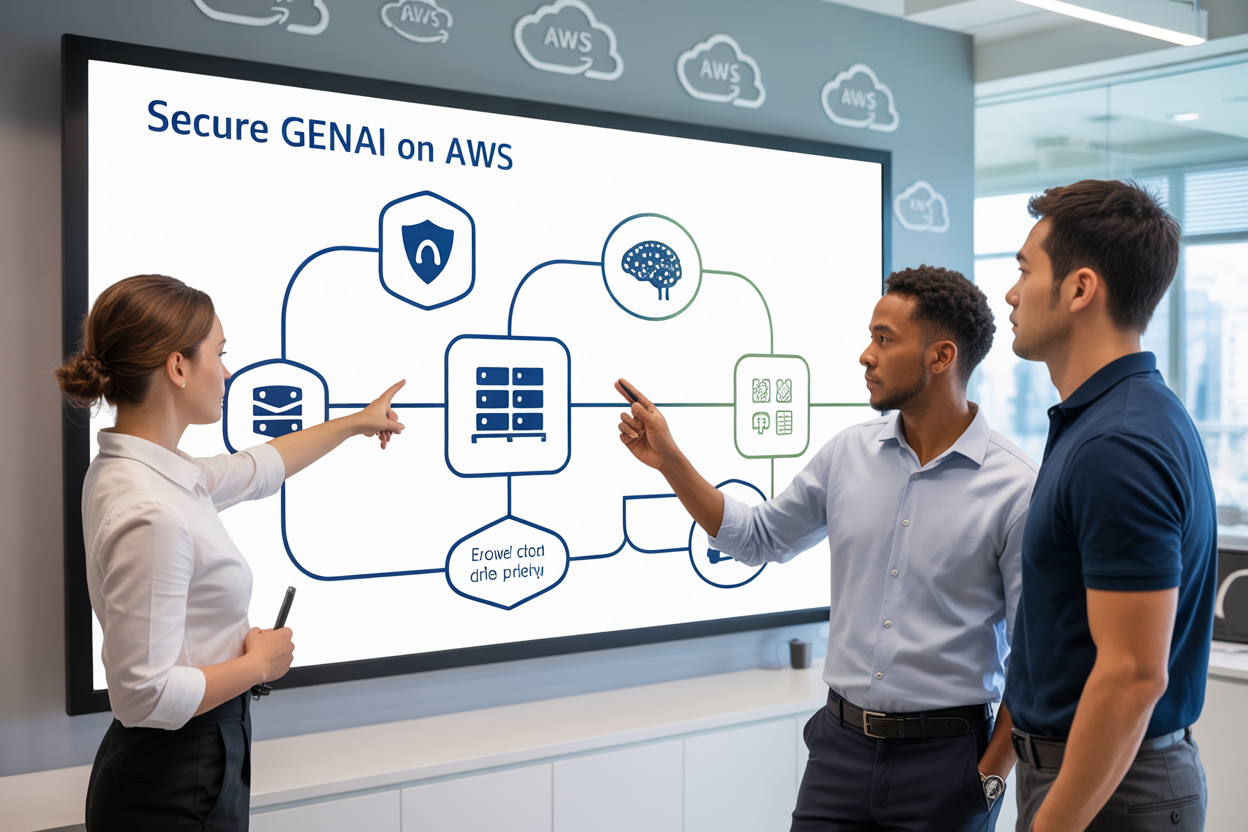
Organizations are rapidly deploying generative AI applications, but many struggle with balancing innovation speed against security requirements and regulatory compliance. This guide targets cloud architects, security engineers, and AI/ML teams who need to build secure generative AI deployment strategies on AWS without sacrificing performance or scalability.
Generative AI workloads present unique challenges that traditional security approaches can’t fully address. Data flows through complex inference pipelines, model outputs require real-time validation, and compliance frameworks are still catching up to AI-specific risks. Getting AWS GenAI security right from the start prevents costly retrofits and regulatory headaches down the road.
We’ll walk through proven AWS AI security controls that protect your models and data throughout the inference lifecycle. You’ll learn how to design scalable AI inference AWS architectures that meet enterprise governance requirements while maintaining the flexibility your teams need. Finally, we’ll cover GenAI compliance monitoring strategies that give you visibility into model behavior and help you demonstrate regulatory adherence.
Understanding GenAI Security Fundamentals on AWS

Identifying Critical Security Vulnerabilities in AI Model Deployment
GenAI models face unique attack vectors including prompt injection attacks, model poisoning, and data extraction vulnerabilities. AWS GenAI security requires implementing robust input validation, sandboxed execution environments, and regular vulnerability assessments. Organizations must address model drift monitoring, adversarial inputs, and unauthorized access to training data through comprehensive threat modeling and security testing protocols.
Establishing Data Protection Standards for Machine Learning Workloads
Data protection for AI workloads demands encryption at rest and in transit using AWS KMS, implementing data classification schemes, and establishing retention policies. Organizations need data lineage tracking, anonymization techniques for sensitive datasets, and secure data pipelines that comply with privacy regulations. AWS services like Macie help identify and protect personally identifiable information throughout the ML lifecycle.
Implementing Access Controls for AI Model Endpoints
Secure AI inference architecture requires implementing IAM policies, API Gateway authentication, and VPC endpoint configurations to control access to GenAI models. Role-based access controls should include fine-grained permissions for model invocation, monitoring, and administration. Multi-factor authentication, temporary credentials, and least-privilege principles protect against unauthorized model access while enabling legitimate business use cases.
Ensuring Compliance with Industry Regulations and Standards
GenAI compliance monitoring involves adhering to frameworks like SOC 2, GDPR, HIPAA, and industry-specific regulations through automated compliance checks and audit trails. AWS Config Rules and CloudTrail provide continuous monitoring of AI governance best practices. Organizations must document model decisions, maintain data provenance records, and implement explainability features to meet regulatory requirements for AI transparency and accountability.
Building Robust Governance Frameworks for GenAI Operations

Defining Model Approval Processes and Version Control
Successful generative AI governance frameworks start with clear model approval workflows that track every AI model from development through production deployment. Organizations need standardized gates where security teams, data scientists, and business stakeholders review model performance, bias metrics, and compliance requirements before releasing updates. AWS SageMaker Model Registry provides centralized version control, allowing teams to maintain audit trails of model iterations while enforcing approval checkpoints. Smart teams implement automated testing pipelines that validate model behavior against predefined safety benchmarks, ensuring only thoroughly vetted models reach production environments where they can impact business operations.
Creating Automated Monitoring and Audit Trails
Real-time monitoring transforms GenAI compliance monitoring from reactive damage control into proactive risk management. AWS CloudTrail captures every API call and model interaction, creating comprehensive audit trails that satisfy regulatory requirements while enabling rapid incident response. CloudWatch dashboards display key performance indicators like inference latency, token usage, and error rates, alerting administrators when models behave unexpectedly. Automated logging systems track data lineage, user access patterns, and output classifications, building detailed forensic capabilities that support both internal reviews and external audits. These monitoring frameworks become essential when scaling AI workloads across multiple teams and business units.
Establishing Risk Assessment Protocols for AI Deployment
Effective AI governance best practices require structured risk evaluation before deploying any generative AI system into production environments. Teams should develop scoring matrices that evaluate models across dimensions like data sensitivity, output accuracy, potential bias, and regulatory impact. AWS Config Rules automate compliance checks against organizational policies, flagging deployments that violate security standards or data handling requirements. Risk assessments must include red team exercises where adversarial prompts test model robustness and safety guardrails. Documentation requirements ensure decision-makers understand the trade-offs between model capabilities and associated risks, creating accountability throughout the deployment lifecycle.
Designing Scalable Inference Architectures with AWS Services

Leveraging Amazon SageMaker for Secure Model Hosting
Amazon SageMaker provides enterprise-grade security features for hosting GenAI models through VPC isolation, encryption at rest and in transit, and IAM-based access controls. The platform’s multi-model endpoints enable cost-effective deployment while maintaining security boundaries between different AI workloads. SageMaker’s built-in monitoring capabilities track model performance and detect anomalies, supporting robust AI governance frameworks. Real-time inference endpoints can be configured with custom security groups and subnet configurations to align with organizational compliance requirements.
Implementing Load Balancing and Auto-Scaling for High Availability
Application Load Balancers distribute GenAI inference requests across multiple SageMaker endpoints, preventing single points of failure in scalable AI inference AWS deployments. Auto-scaling policies automatically adjust endpoint capacity based on CloudWatch metrics like CPU utilization and request latency. Target tracking scaling ensures consistent response times during traffic spikes while minimizing costs during low-demand periods. Cross-zone load balancing enhances fault tolerance by distributing traffic across multiple Availability Zones, creating resilient secure AI inference architecture patterns.
Optimizing Performance with AWS Inferentia and GPU Instances
AWS Inferentia chips deliver up to 80% cost savings for transformer-based models while maintaining low latency for GenAI workloads. GPU instances like P4d and P5 provide exceptional performance for large language models requiring high memory bandwidth. Instance selection depends on model size, throughput requirements, and cost constraints within your AI governance best practices. Batch inference jobs on Spot instances can reduce costs by up to 90% for non-real-time workloads while maintaining security controls through proper IAM policies and encryption.
Creating Multi-Region Deployment Strategies
Multi-region deployments enhance disaster recovery capabilities and reduce latency for global GenAI applications through strategic placement of inference endpoints. Cross-region replication of model artifacts using S3 ensures consistent deployments while maintaining data sovereignty requirements. Route 53 health checks automatically redirect traffic to healthy regions, supporting business continuity objectives. Regional deployment strategies must consider data residency requirements, network latency patterns, and compliance regulations specific to each geographic location where AI services operate.
Implementing Advanced Security Controls for AI Workloads

Configuring Network Isolation with VPC and Security Groups
Creating isolated network environments for GenAI workloads requires strategic VPC design with dedicated subnets for inference endpoints. Security groups act as virtual firewalls, controlling inbound and outbound traffic to Amazon SageMaker endpoints and compute instances. Private subnets ensure AI models remain isolated from public internet access while enabling secure communication through NAT gateways. Network ACLs provide additional subnet-level security, creating defense-in-depth protection. VPC endpoints for AWS services eliminate internet traffic routing, keeping data flows within the AWS backbone network.
Encrypting Data in Transit and at Rest
AWS GenAI security demands comprehensive encryption strategies protecting sensitive training data and model outputs. Amazon SageMaker automatically encrypts model artifacts and training data using AWS KMS customer-managed keys. TLS 1.2 encryption secures all API communications between applications and inference endpoints. S3 bucket encryption with SSE-KMS protects stored datasets, while EBS volume encryption safeguards compute instance storage. Certificate Manager handles SSL/TLS certificates for custom domains, ensuring encrypted connections throughout the AI pipeline without manual certificate management overhead.
Setting Up Identity and Access Management for AI Resources
IAM policies for AI workloads follow least-privilege principles, granting minimal permissions required for specific GenAI operations. Role-based access control separates data scientists, MLOps engineers, and application developers with distinct permission boundaries. SageMaker execution roles define precise actions for training jobs and inference endpoints, preventing unauthorized model access. Cross-account roles enable secure resource sharing between development, staging, and production environments. IAM Access Analyzer continuously reviews permissions, identifying unused access rights and potential security gaps in AI resource configurations.
Monitoring Threats with AWS Security Services
AWS Security Hub centralizes security findings from multiple services, providing unified visibility into GenAI infrastructure threats. GuardDuty uses machine learning to detect anomalous API calls and potential data exfiltration attempts targeting AI resources. CloudTrail logs capture all API activities across SageMaker, S3, and related services for forensic analysis. AWS Config monitors configuration compliance, alerting administrators when security settings drift from established baselines. Amazon Macie identifies sensitive data patterns in S3 buckets containing training datasets, preventing accidental exposure of personally identifiable information through automated classification scanning.
Establishing Continuous Monitoring and Compliance

Tracking Model Performance and Drift Detection
Monitoring your GenAI models requires setting up automated systems that track accuracy metrics, response quality, and behavioral changes over time. AWS CloudWatch works alongside Amazon SageMaker Model Monitor to detect when your models start producing unexpected outputs or show performance degradation. Real-time alerts help you catch issues before they impact users, while historical data analysis reveals patterns that might indicate training data becoming outdated or model behavior shifting unexpectedly.
Implementing Real-Time Security Monitoring
Your AWS GenAI security monitoring strategy needs continuous oversight of access patterns, unusual query volumes, and potential data leakage attempts. CloudTrail logs every API call while Amazon GuardDuty scans for suspicious activities across your AI infrastructure. Custom security dashboards display real-time threat indicators, and automated response systems can immediately isolate compromised resources or block malicious requests before they reach your generative AI models.
Creating Automated Compliance Reporting Systems
Building automated compliance reporting for GenAI operations streamlines audit processes and ensures consistent documentation of security controls. AWS Config Rules automatically check your AI infrastructure against compliance standards while Lambda functions generate detailed reports showing model access logs, data handling procedures, and security control effectiveness. These systems create audit trails that demonstrate adherence to regulatory requirements and internal governance policies without manual intervention.

Setting up secure GenAI inference architectures on AWS requires a balanced approach that covers security fundamentals, governance frameworks, and scalable design patterns. The key is building systems that protect your AI workloads while maintaining the performance and flexibility your organization needs. From implementing proper access controls and data encryption to establishing monitoring systems that catch issues before they become problems, every piece works together to create a reliable foundation for your AI operations.
The real success comes from treating security and governance as ongoing practices rather than one-time setup tasks. Start with AWS’s native security services and build your governance framework around your specific use cases and compliance requirements. Regular monitoring and continuous improvement will keep your GenAI systems running smoothly and securely as your needs evolve. Take the first step by assessing your current setup and identifying which security controls would have the biggest impact on your AI workloads today.
The post Secure and Governed GenAI Inference Architectures on AWS first appeared on Business Compass LLC.
from Business Compass LLC https://ift.tt/1UBDQTy
via IFTTT


Comments
Post a Comment