Multi-Region AWS Architecture: Capabilities and Constraints
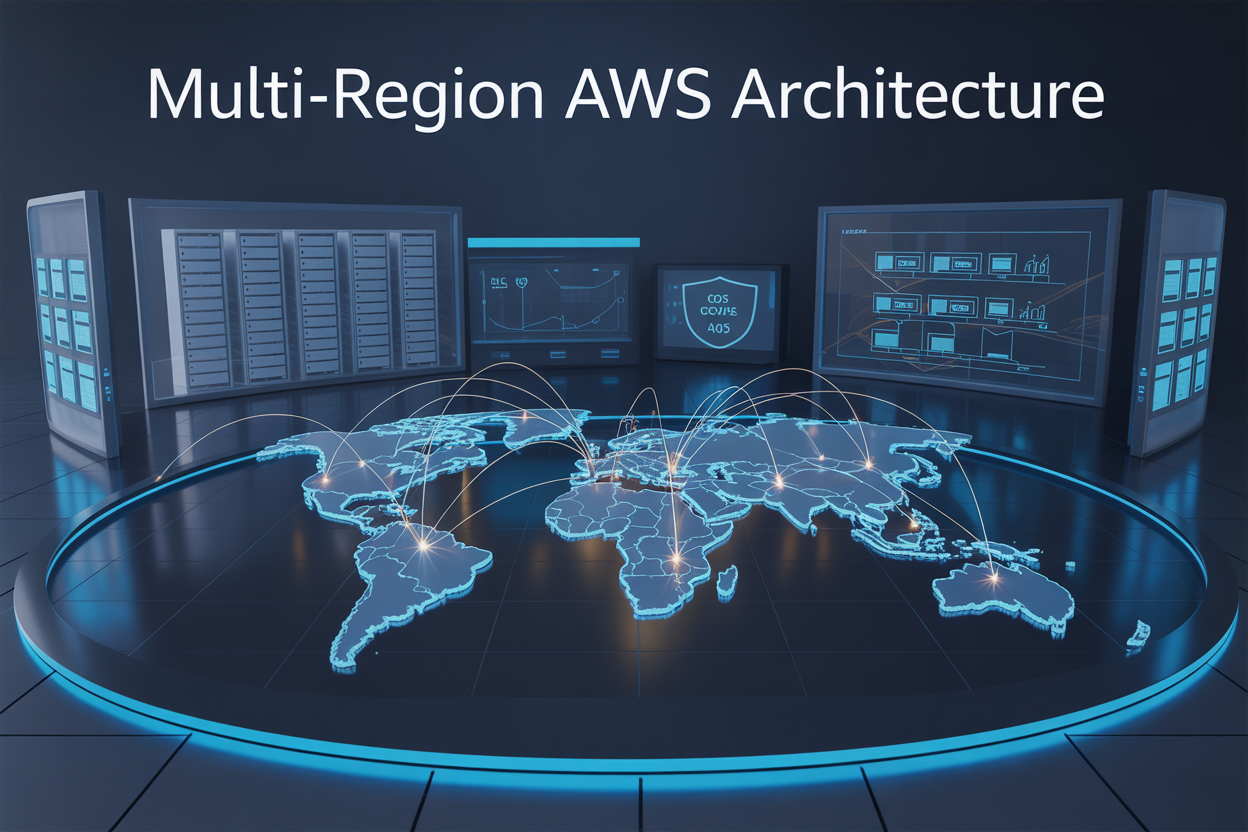
Multi-region AWS architecture delivers global reach, disaster recovery, and high availability for enterprise applications, but comes with significant complexity and cost trade-offs. This guide is for cloud architects, DevOps engineers, and technical leaders planning AWS global infrastructure design or evaluating multi-region deployment strategies.
You’ll discover the core components that make AWS multi region deployment possible, including how services like Route 53, CloudFront, and RDS work across regions. We’ll examine the key capabilities this architecture unlocks, from automated AWS cross-region failover to improved user experience through reduced latency.
The discussion covers practical data replication strategies, AWS multi-region security best practices, and the real costs behind running workloads globally. We’ll also address the technical constraints and implementation hurdles that can make or break your multi-region AWS cost optimization efforts.
Core Components of Multi-Region AWS Infrastructure

Regional Data Centers and Availability Zones Distribution
AWS spans multiple regions across the globe, with each region containing multiple Availability Zones (AZs) that act as isolated data centers. When designing a multi-region AWS architecture, you’re working with geographically separated regions like US East (Virginia), EU West (Ireland), or Asia Pacific (Singapore). Each region operates independently, giving you the foundation for true disaster recovery capabilities.
Within each region, AZs provide fault isolation while maintaining low-latency connections. A well-designed multi-region AWS deployment typically places primary workloads in one region while maintaining standby resources in secondary regions. This distribution strategy ensures your applications can survive entire regional outages.
The key advantage lies in AWS’s physical separation of regions – they’re far enough apart to avoid correlated failures from natural disasters or infrastructure issues. You can deploy identical application stacks across multiple regions, creating redundancy that goes beyond traditional data center approaches.
Cross-Region Networking and Connectivity Options
Connecting multiple AWS regions requires careful planning of your networking strategy. VPC Peering allows direct communication between Virtual Private Clouds across regions, creating encrypted connections over AWS’s backbone network. This approach works well for simple architectures but can become complex with multiple regions.
AWS Transit Gateway offers a more scalable solution for multi-region connectivity. You can create Transit Gateway peering connections between regions, establishing a hub-and-spoke model that simplifies routing and management. This becomes especially valuable when connecting more than three regions.
For hybrid scenarios, AWS Direct Connect provides dedicated network connections from your on-premises infrastructure to multiple AWS regions. You can use Direct Connect Gateways to route traffic between your data centers and various AWS regions through a single connection.
VPN connections serve as backup connectivity options or primary connections for smaller deployments. Site-to-Site VPN can establish encrypted tunnels between regions or from on-premises to multiple regions simultaneously.
Global Load Balancing and Traffic Management
Route 53, AWS’s DNS service, plays a crucial role in multi-region traffic distribution. Its health checks continuously monitor your regional endpoints, automatically routing traffic away from failed regions. You can configure routing policies like weighted routing to gradually shift traffic between regions during deployments or failover scenarios.
Application Load Balancers (ALBs) and Network Load Balancers (NLBs) operate within regions but can work together with Route 53 for global traffic management. Each region typically hosts its own load balancer, with Route 53 directing users to the closest healthy region based on latency or geographic proximity.
Geolocation routing ensures users from specific countries or continents connect to designated regions, helping with data residency requirements and performance optimization. Latency-based routing automatically directs traffic to the region providing the lowest latency for each user.
For more advanced traffic management, you can implement blue-green deployments across regions, where Route 53 instantly switches traffic from one regional deployment to another during updates or maintenance windows.
Edge Locations and CloudFront Integration
CloudFront edge locations extend your multi-region AWS architecture to the network edge, bringing content and applications closer to end users worldwide. With over 400 edge locations globally, CloudFront can cache static content and accelerate dynamic content from your regional origins.
Your multi-region setup benefits from CloudFront’s origin failover capabilities. You can configure multiple origins pointing to different regions, with CloudFront automatically switching to secondary origins when primary regions become unavailable. This creates an additional layer of resilience for your AWS global infrastructure design.
Lambda@Edge functions run at CloudFront edge locations, enabling you to execute code closer to users. This capability allows for request modification, authentication, and content personalization without round trips to your regional infrastructure.
CloudFront’s integration with AWS Shield and AWS WAF provides DDoS protection and web application firewall capabilities at the edge, protecting your multi-region architecture before malicious traffic reaches your regional resources. The service automatically scales to handle traffic spikes across all edge locations.
Key Capabilities Enabled by Multi-Region Design

Enhanced Disaster Recovery and Business Continuity
Multi-region AWS architecture transforms disaster recovery from a complex, expensive undertaking into a manageable, automated process. When your primary region experiences an outage, your applications can automatically failover to secondary regions within minutes rather than hours or days.
AWS cross-region failover capabilities include automated database replication through RDS Multi-AZ deployments and read replicas across regions. Amazon S3 Cross-Region Replication ensures your data stays synchronized, while Route 53 health checks automatically redirect traffic when issues arise. This setup dramatically reduces Recovery Time Objectives (RTO) and Recovery Point Objectives (RPO) compared to traditional backup strategies.
The real power lies in active-active configurations where multiple regions handle production traffic simultaneously. If one region fails, the remaining regions absorb the load without service interruption. This approach eliminates the concept of a “cold” disaster recovery site that needs warming up during emergencies.
Financial institutions and healthcare organizations particularly benefit from this AWS high availability architecture, as regulatory requirements often mandate specific uptime guarantees and data protection standards. The ability to maintain operations during regional disasters protects both revenue and reputation.
Improved Global Performance and Reduced Latency
Geographic proximity to users directly impacts application performance, and multi-region AWS deployment addresses this challenge head-on. By distributing workloads across regions closer to your user base, you can achieve significant latency reductions that translate to better user experiences.
AWS global load balancing through Application Load Balancers and CloudFront edge locations creates intelligent traffic routing based on user location, server health, and current load. A user in Tokyo connects to resources in the Asia Pacific region rather than waiting for data to travel from a single US-based deployment.
Database performance sees substantial improvements through read replicas positioned strategically worldwide. Read-heavy workloads like content management systems, e-commerce catalogs, and reporting dashboards benefit from regional read replicas that serve local users without crossing continents.
Content delivery becomes lightning-fast when combined with CloudFront’s global edge network. Static assets, API responses, and dynamic content cache at edge locations, reducing load times from seconds to milliseconds for repeat visitors.
Real-time applications like gaming, video streaming, and collaborative tools experience dramatic performance gains. Users expect sub-100ms response times, which becomes achievable only through strategic global infrastructure design.
Scalable Geographic Distribution of Workloads
Multi-region architecture enables true global scalability by allowing workloads to expand beyond the constraints of a single geographic location. This distribution strategy supports growing user bases, regulatory compliance requirements, and business expansion into new markets.
Auto Scaling Groups can operate across multiple regions simultaneously, automatically launching instances where demand is highest. During peak usage periods in different time zones, resources scale up in the appropriate regions while scaling down in others, optimizing both performance and costs.
Microservices architectures particularly shine in multi-region deployments. Individual services can run in regions that make the most sense for their specific requirements. User authentication services might centralize in one region for consistency, while content processing services distribute globally for performance.
Data sovereignty requirements become manageable through regional workload distribution. European user data stays within EU regions to comply with GDPR, while US data remains within appropriate boundaries. This geographic separation happens transparently to users while maintaining application functionality.
Container orchestration through Amazon EKS supports cross-region deployments with centralized management. Kubernetes clusters in multiple regions can share configurations while maintaining regional independence, enabling sophisticated deployment strategies like blue-green deployments across continents.
The flexibility to migrate workloads between regions based on changing business needs, cost considerations, or performance requirements provides strategic advantages that single-region architectures simply cannot match.
Data Replication and Synchronization Strategies

Real-Time Cross-Region Database Replication
AWS offers several powerful solutions for real-time database replication across regions. Amazon RDS provides cross-region read replicas that maintain synchronized copies of your primary database, enabling near-instantaneous failover capabilities. RDS Multi-AZ deployments can be extended across regions using Global Database clusters, particularly effective with Amazon Aurora.
DynamoDB Global Tables represent another robust option for multi-region data replication AWS environments. This service automatically replicates your DynamoDB tables across multiple AWS regions, providing millisecond-latency access to data regardless of user location. The system handles conflict resolution automatically through last-writer-wins semantics.
For NoSQL workloads, Amazon DocumentDB supports cross-region snapshot copying, while Amazon ElastiCache offers Global Datastore functionality for Redis clusters. These services maintain data consistency while minimizing replication lag.
Real-time replication comes with network latency considerations. Cross-region network delays typically range from 50-150 milliseconds depending on geographic distance, which directly impacts synchronous replication performance. Most AWS multi region deployment scenarios benefit from asynchronous replication to balance consistency with performance.
Asynchronous Data Backup and Recovery Methods
Asynchronous replication strategies provide excellent balance between data protection and system performance. Amazon S3 Cross-Region Replication automatically copies objects to destination buckets in different regions based on configured rules. This approach works exceptionally well for static content, application assets, and backup archives.
AWS Backup offers centralized backup management across multiple AWS services and regions. You can create backup policies that automatically replicate critical data to secondary regions on scheduled intervals. The service supports point-in-time recovery and integrates seamlessly with EC2, RDS, DynamoDB, EFS, and other AWS services.
Database-specific backup strategies include RDS automated backups with cross-region snapshot copying. These snapshots can be automated to copy to multiple regions, providing reliable recovery points. Aurora backtrack capability allows you to rewind your database to specific timestamps without restoring from backups.
Lambda functions can orchestrate custom backup workflows, triggering cross-region data transfers based on business logic. These serverless approaches reduce operational overhead while maintaining flexible backup schedules tailored to your AWS disaster recovery architecture requirements.
Storage Solutions for Multi-Region Environments
Amazon S3 serves as the backbone for most multi-region storage architectures. S3 Transfer Acceleration uses CloudFront’s globally distributed edge locations to speed up uploads to your S3 buckets. Combined with Cross-Region Replication, this creates a robust foundation for global content distribution.
Amazon EFS supports regional file systems with backup capabilities to other regions. While EFS doesn’t natively support cross-region synchronization, AWS DataSync can efficiently transfer data between EFS file systems across regions. This combination works well for applications requiring shared file storage with disaster recovery capabilities.
FSx file systems offer high-performance storage options with backup-to-S3 functionality. FSx for Windows File Server and FSx for Lustre both support cross-region backup strategies, though real-time synchronization requires custom solutions using DataSync or third-party tools.
Amazon EBS volumes can be backed up using EBS snapshots, which copy to S3 and can be shared across regions. Automated snapshot policies ensure regular backups without manual intervention. EBS Multi-Attach enables shared storage scenarios within single availability zones, though cross-region sharing requires snapshot-based approaches.
Storage Gateway provides hybrid cloud storage integration, connecting on-premises environments to AWS storage services across multiple regions. This service bridges local storage with cloud-based multi-region architectures effectively.
Data Consistency and Conflict Resolution Mechanisms
Multi-region architectures must address eventual consistency challenges inherent in distributed systems. AWS services implement various consistency models depending on use case requirements. S3 provides strong read-after-write consistency for new objects and eventual consistency for overwrite operations and deletes.
DynamoDB Global Tables use conflict resolution through timestamps and last-writer-wins logic. When conflicting updates occur across regions, the system automatically resolves conflicts based on the most recent timestamp. This approach works well for many applications but requires careful consideration of concurrent update scenarios.
Custom conflict resolution strategies become necessary for complex business logic requirements. Application-level conflict resolution can implement business rules that determine winning records based on criteria beyond simple timestamps. Version vectors and vector clocks provide more sophisticated conflict detection mechanisms for distributed systems.
RDS and Aurora handle consistency through their replication mechanisms. Aurora Global Database maintains a primary region with up to five secondary regions, each handling read operations with typically less than one second of replication lag. Cross-region failover promotes a secondary region to primary when needed.
Implementing AWS global infrastructure design requires understanding CAP theorem trade-offs. Most AWS multi-region deployments prioritize availability and partition tolerance over strong consistency, making eventual consistency models more practical for large-scale distributed applications. Monitoring tools like CloudWatch and X-Ray help track replication lag and identify consistency issues across your multi-region infrastructure.
Security and Compliance Considerations

Cross-Region Identity and Access Management
Managing user identities and permissions across multiple AWS regions creates complexity that requires careful planning. AWS Identity and Access Management (IAM) operates globally by default, meaning IAM users, groups, roles, and policies exist across all regions within your AWS account. This global nature provides consistency but demands strategic thinking about access controls.
When deploying multi-region AWS architecture, you need to consider how your IAM policies handle region-specific resources. Service-linked roles automatically replicate across regions, but custom roles require explicit configuration for cross-region resource access. The challenge intensifies when implementing least-privilege principles while ensuring applications can function seamlessly across regions during normal operations and failover scenarios.
Cross-region assume role chains become critical for service-to-service communication in multi-region deployments. Applications running in one region might need to access resources in another region during AWS cross-region failover events. Setting up these trust relationships properly prevents authentication failures during disaster recovery scenarios while maintaining security boundaries.
Regional STS (Security Token Service) endpoints add another layer of complexity. While STS operates globally, regional endpoints can improve latency and provide redundancy. However, temporary credentials issued by one regional STS endpoint work across all regions, creating potential security considerations that teams must address through proper token lifecycle management.
Data Sovereignty and Regional Compliance Requirements
Data sovereignty laws vary significantly across different geographical regions, making compliance a primary concern in multi-region AWS deployments. GDPR in Europe, data localization requirements in Russia, and sector-specific regulations like HIPAA in the United States create a complex web of compliance requirements that directly impact your AWS global infrastructure design.
AWS regions are designed with data sovereignty in mind – data doesn’t leave a region unless you explicitly configure it to do so. This design principle helps organizations comply with local data residency requirements, but it requires careful planning for multi-region data replication AWS strategies. You must understand which data can cross regional boundaries and implement appropriate controls.
Compliance frameworks often require specific documentation about data flows between regions. When implementing multi-region architecture, maintain detailed records of:
- What data types move between regions
- Encryption methods used during transit and at rest
- Data retention policies per region
- Audit trails for cross-region data access
Some regulations require data processing to occur within specific geographical boundaries. This requirement affects where you place compute resources and how you design your application architecture. Financial services companies, for example, might need to ensure that transaction processing happens within specific regulatory zones while still maintaining disaster recovery capabilities.
Regional compliance also extends to third-party integrations and data processors. When your multi-region architecture includes external services, you need to verify that these services meet compliance requirements in each region where they operate.
Network Security Across Multiple Regions
Securing network communications across multiple AWS regions requires a multi-layered approach that goes beyond basic VPC configurations. Inter-region traffic travels over AWS’s private backbone network, but you still need to implement proper encryption and access controls to protect sensitive data in transit.
VPC peering connections provide direct network routes between regions, but they require careful security group and network ACL configuration. Each peering connection creates a potential attack vector, so implement the principle of least privilege by allowing only necessary traffic flows. Route table configurations become critical – overly permissive routing can expose resources unintentionally.
AWS Transit Gateway with inter-region peering offers more sophisticated network topologies for complex multi-region deployments. This approach provides centralized connectivity management and better network segmentation capabilities. However, it requires expertise in advanced networking concepts and careful bandwidth planning to avoid performance bottlenecks.
Network monitoring across regions demands specialized tooling and processes. VPC Flow Logs, AWS CloudTrail, and third-party network monitoring solutions help detect unusual traffic patterns that might indicate security breaches. Setting up alerting for cross-region traffic anomalies helps security teams respond quickly to potential threats.
Consider implementing dedicated connections like AWS Direct Connect in multiple regions for predictable network performance and additional security. These private connections reduce reliance on internet routing for critical inter-region communications, though they add complexity and cost to your AWS multi-region security best practices implementation.
Cost Implications and Financial Constraints

Data Transfer Costs Between Regions
AWS multi-region data transfer costs can quickly become a budget nightmare if you’re not careful. Every time data moves between regions, AWS charges for the bandwidth, and these fees add up faster than you might expect. Data transfer out of one region to another typically costs between $0.02 to $0.12 per GB, depending on your source and destination regions.
The biggest cost drivers include:
- Database replication for disaster recovery scenarios
- Real-time synchronization of application data
- Backup transfers to secondary regions
- Content delivery for global user bases
- Cross-region API calls and microservice communications
Multi-region AWS cost optimization becomes critical when dealing with high-volume applications. A single application generating 1TB of cross-region traffic monthly can result in $20-120 in transfer fees alone. For enterprise workloads, these costs can reach thousands of dollars monthly.
Regional Pricing Variations
Different region pairs have different pricing structures. Transfers between US regions cost less than transfers between US and Asia-Pacific regions. AWS also offers reduced rates for committed data transfer volumes through Reserved Capacity pricing.
Resource Duplication and Infrastructure Overhead
Multi-region AWS deployment inherently means paying for duplicate infrastructure across multiple geographic locations. This duplication creates significant overhead that goes beyond simple multiplication of single-region costs.
Key duplication costs include:
- Compute resources (EC2 instances, Lambda functions, containers)
- Storage systems (EBS volumes, S3 buckets, database storage)
- Network infrastructure (load balancers, NAT gateways, VPN connections)
- Managed services (RDS instances, ElastiCache clusters, monitoring tools)
- Security components (WAF rules, certificates, KMS keys)
The infrastructure overhead typically increases total costs by 80-150% compared to single-region deployments. This doesn’t account for the operational complexity of managing multiple environments.
Hidden Overhead Costs
Many organizations overlook indirect costs like:
- Cross-region monitoring and logging aggregation
- Compliance auditing across multiple jurisdictions
- Support tier upgrades for complex multi-region troubleshooting
- Training costs for teams managing distributed systems
Optimization Strategies for Multi-Region Spending
Smart AWS global infrastructure design can dramatically reduce multi-region costs without sacrificing reliability or performance. The key lies in strategic resource placement and intelligent data flow management.
Tiered Architecture Approach
Instead of full duplication, consider a tiered approach:
- Primary region: Full production stack with all services
- Secondary region: Essential services only (databases, core APIs)
- Tertiary regions: Read replicas and cached content only
This approach can reduce costs by 40-60% while maintaining AWS high availability architecture benefits.
Data Transfer Optimization
- Use CloudFront for static content delivery instead of cross-region transfers
- Implement regional caching to reduce database query traffic
- Batch data synchronization during off-peak hours for lower bandwidth costs
- Compress data streams before cross-region transmission
- Regional data processing to minimize raw data movement
Smart Failover Design
Design your AWS disaster recovery architecture to minimize costs during normal operations:
- Cold standby for non-critical systems
- Pilot light approach for core services
- Warm standby only for mission-critical components
Reserved Instance Strategy
Purchase Reserved Instances strategically across regions based on actual usage patterns. Mix one-year and three-year terms to balance cost savings with flexibility needs.
Automated Cost Controls
Implement automated cost management:
- Resource scheduling to shut down non-production resources
- Auto-scaling policies that consider regional cost differences
- Budget alerts for cross-region transfer thresholds
- Tagging strategies for detailed cost attribution across regions
Technical Limitations and Implementation Challenges

Network Latency and Performance Trade-offs
Cross-region communication introduces unavoidable latency penalties that can significantly impact application performance. Even with AWS’s high-speed backbone network, data traveling between regions like US-East-1 and EU-West-1 typically experiences 80-150ms round-trip times. This latency becomes problematic for real-time applications, interactive user interfaces, and synchronous database operations.
Performance degradation affects user experience in ways that aren’t always obvious. A multi-region AWS architecture might handle failover beautifully, but users suddenly redirected from a nearby region to a distant one will notice slower page loads and delayed responses. Database queries that normally complete in milliseconds can take several hundred milliseconds when crossing regions, creating cascading effects throughout the application stack.
The bandwidth limitations between regions also constrain data-intensive operations. While AWS provides substantial inter-region bandwidth, it’s finite and comes with additional costs. Large-scale data synchronization, backup operations, or content distribution can saturate available bandwidth, creating bottlenecks that impact other services sharing the same network paths.
Complexity in Configuration and Management
Managing AWS multi region deployment exponentially increases operational complexity compared to single-region architectures. Each additional region multiplies the number of resources, configurations, and potential failure points that teams must monitor and maintain. Infrastructure as Code templates become more intricate, requiring careful orchestration of dependencies across geographic boundaries.
Service configurations that work seamlessly within a single region often require extensive modification for multi-region scenarios. Load balancers need health checks across regions, auto-scaling groups require coordination to prevent resource conflicts, and monitoring systems must aggregate data from multiple locations while accounting for time zone differences and regional variations in metric collection.
The learning curve for engineers increases dramatically when implementing AWS cross-region failover mechanisms. Teams must understand region-specific networking, master complex routing policies, and develop expertise in managing distributed systems. This knowledge requirement often leads to longer development cycles and higher chances of configuration errors that can compromise the entire multi-region setup.
Service Availability Variations Across Regions
AWS service availability varies significantly across regions, creating unexpected limitations in multi-region AWS architecture designs. Not all regions offer the same services, and new features often roll out to established regions months before reaching newer locations. This disparity forces architects to either limit their service choices to the lowest common denominator or accept functional differences between regions.
Instance types, storage options, and specialized services like machine learning offerings differ between regions. An application designed around specific EC2 instance families might face performance penalties or increased costs when deployed to regions where those instances aren’t available. These variations can disrupt carefully planned capacity and performance expectations.
Regional service limits also create asymmetric constraints. One region might support larger RDS instances or higher Lambda concurrency limits than another, forcing uneven resource distribution. During high-demand periods, these differences become more pronounced as some regions hit capacity limits while others have available resources, complicating load distribution strategies.
Integration Challenges with Third-Party Services
Third-party service integration becomes substantially more complex in multi-region environments. Many SaaS providers, monitoring tools, and external APIs don’t offer the same global distribution as AWS, creating single points of failure that undermine the redundancy benefits of AWS disaster recovery architecture.
API endpoints for external services often route to specific geographic locations, introducing latency and availability risks. A payment processor with primary infrastructure in the US East Coast might cause transaction delays for applications running in Asian AWS regions. These external dependencies can become the weakest links in otherwise robust multi-region designs.
Authentication and authorization services present particular challenges when distributed across regions. Single sign-on providers, certificate authorities, and identity management systems may not replicate user states quickly enough to support seamless failover. Users might find themselves unable to authenticate when traffic shifts to a different region, even though the underlying application infrastructure remains healthy.
Compliance requirements add another layer of complexity to third-party integrations. Data residency regulations might prevent certain services from operating in specific regions, forcing architects to implement region-specific integration strategies that increase both complexity and maintenance overhead.

Building a multi-region AWS architecture opens up powerful capabilities for your applications, from improved disaster recovery and reduced latency to enhanced global reach. The combination of strategic data replication, robust security measures, and careful region selection can transform how your systems perform and scale. However, these benefits come with real trade-offs in complexity, cost, and management overhead that require honest evaluation against your specific business needs.
The key to success lies in starting simple and scaling thoughtfully. Don’t rush into a multi-region setup just because it sounds impressive – evaluate whether your workloads truly need this level of distribution and resilience. If they do, invest time in understanding the data consistency models, security implications, and ongoing operational costs before diving in. The most effective multi-region architectures are those that solve real problems rather than create impressive diagrams.
The post Multi-Region AWS Architecture: Capabilities and Constraints first appeared on Business Compass LLC.
from Business Compass LLC https://ift.tt/FTgUjp7
via IFTTT


Comments
Post a Comment