Migrating Legacy .NET Banking Systems to AWS Microservices
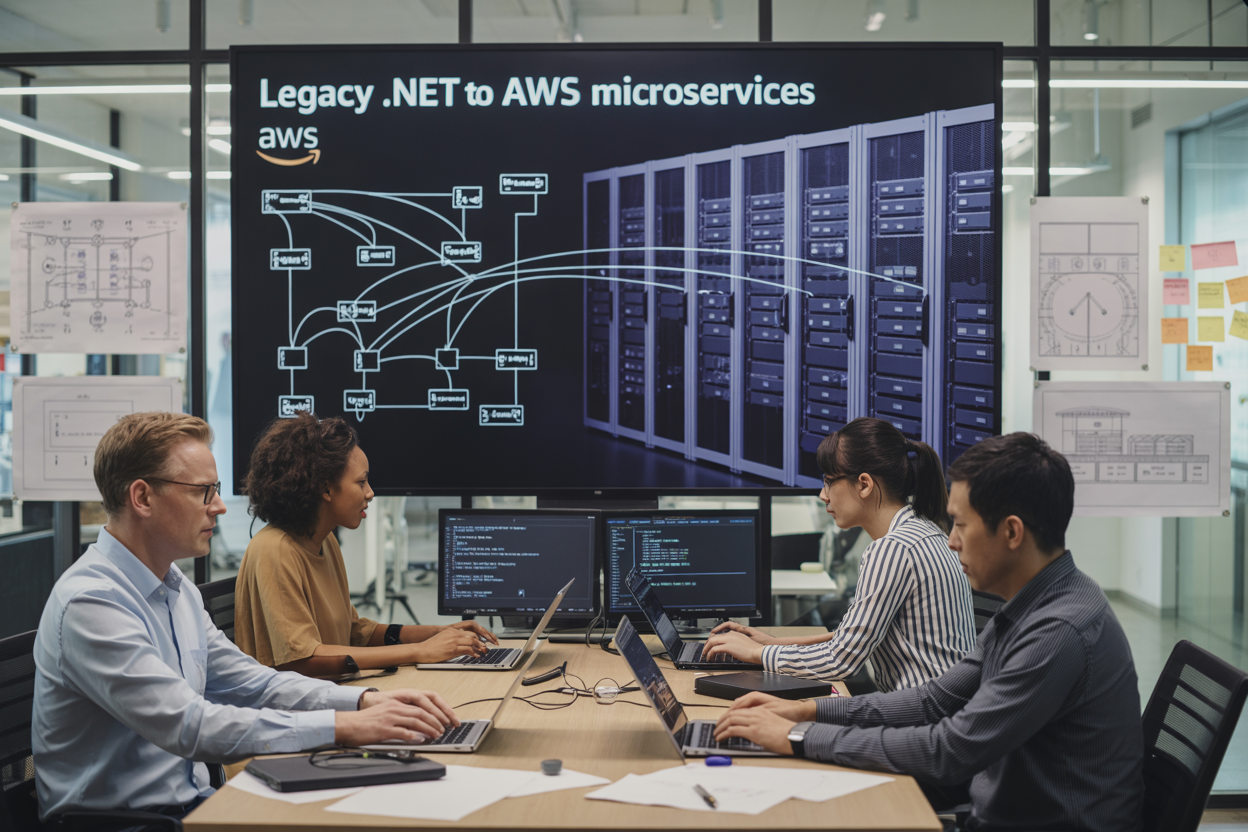
Legacy .NET banking systems are hitting their limits, and financial institutions need modern solutions that can scale, adapt, and meet today’s security demands. This guide walks you through migrating legacy .NET banking systems to AWS microservices, helping banking IT leaders, solution architects, and development teams break free from monolithic constraints.
You’ll discover how AWS microservices banking architecture transforms rigid legacy systems into flexible, cloud-native solutions. We’ll cover the core challenges plaguing traditional .NET banking platforms and show you how banking system modernization addresses compliance, performance, and integration headaches.
This comprehensive resource explores pre-migration planning strategies that minimize risk and downtime, plus AWS banking solutions selection criteria to match your specific workloads. You’ll also learn migration implementation best practices that keep your banking operations running smoothly throughout the transition, along with post-migration optimization techniques that maximize your cloud investment.
Understanding Legacy .NET Banking System Challenges

Identifying monolithic architecture bottlenecks
Most legacy .NET banking systems were built as single, massive applications where every component connects to one central database. Picture trying to change a single feature in your banking application – you often need to rebuild and redeploy the entire system. This creates serious bottlenecks when different business units want to move at different speeds.
Customer-facing applications become tightly coupled with back-office processing systems, meaning a simple update to the mobile app interface might require coordination with the loan processing team. Database connections become shared resources that create contention during high-traffic periods. When the mortgage department runs batch processes overnight, it can slow down ATM transactions the next morning.
Performance suffers because these monolithic .NET banking systems can’t scale individual components based on demand. During month-end processing, the reporting module might need extra resources, but the entire application has to scale up, wasting resources on components that aren’t experiencing heavy load.
Assessing security vulnerabilities and compliance gaps
Legacy banking modernization reveals security challenges that weren’t apparent when these systems were first deployed. Older .NET frameworks often lack modern security features like advanced encryption protocols and multi-factor authentication integration that regulators now require.
These systems typically store sensitive customer data across multiple database tables without proper data classification or access controls. A single security breach can expose everything from account numbers to transaction histories because there’s no proper data segmentation.
Compliance becomes increasingly difficult when audit trails span across interconnected modules within the monolith. Tracking data lineage for regulatory reporting becomes nearly impossible when customer information flows through dozens of tightly coupled components.
Many legacy systems rely on custom authentication mechanisms that don’t integrate well with modern identity management solutions, creating compliance gaps around access monitoring and user provisioning.
Evaluating scalability limitations during peak loads
.NET banking system migration often becomes necessary when existing infrastructure can’t handle modern transaction volumes. Legacy systems struggle during peak periods like payroll dates, holiday shopping seasons, or when promotional campaigns drive unexpected traffic spikes.
Traditional scaling approaches require duplicating the entire application stack, even when only specific components like payment processing or account inquiry services experience high demand. This leads to expensive over-provisioning and inefficient resource usage.
Database bottlenecks become particularly problematic as transaction volumes grow. Single database architectures can’t distribute load effectively, causing slowdowns that impact customer experience across all banking channels simultaneously.
Legacy .NET applications often can’t take advantage of cloud-native scaling features like auto-scaling groups or load balancing across multiple availability zones, limiting their ability to handle geographic traffic distribution.
Analyzing maintenance costs and technical debt
Technical debt in legacy banking systems grows exponentially over time. Older .NET frameworks require specialized developers who command premium salaries, making talent acquisition expensive and risky for long-term operations.
Code maintenance becomes increasingly complex as patches and workarounds accumulate over years of operation. Simple changes require extensive regression testing across interconnected modules, inflating development timelines and costs.
Licensing costs for legacy database systems and middleware often include expensive support contracts that don’t align with modern cloud pricing models. Organizations find themselves paying premium prices for features they don’t use while missing modern capabilities they need.
Infrastructure maintenance requires dedicated hardware, specialized networking equipment, and disaster recovery sites that consume significant capital and operational budgets compared to cloud-native alternatives that AWS microservices banking solutions provide.
AWS Microservices Architecture Benefits for Banking

Enhanced fault isolation and system resilience
Banking systems demand rock-solid reliability, and AWS microservices banking architecture delivers this through superior fault isolation. When legacy .NET banking systems operate as monoliths, a single component failure can bring down the entire application, potentially affecting millions of customers and transactions.
Breaking down monolithic .NET banking applications into microservices creates natural boundaries between different functions. Your payment processing service runs independently from your account management system, which operates separately from loan origination workflows. This architectural shift means that if one service experiences issues, the rest continue functioning normally.
AWS provides several tools to strengthen this isolation:
- Amazon ECS and EKS containerize individual banking services, ensuring resource isolation and consistent deployment environments
- AWS Lambda enables serverless banking functions that automatically scale and isolate from other components
- Application Load Balancer intelligently routes traffic away from unhealthy services
- Amazon RDS Multi-AZ deployments protect critical banking data with automatic failover capabilities
Independent scaling of critical banking functions
Legacy banking modernization through microservices unlocks granular scaling capabilities that monolithic systems simply cannot match. Different banking functions experience varying load patterns throughout the day, month, and year.
Your mobile banking API might see heavy traffic during lunch hours and evenings, while batch processing for statement generation peaks overnight. ATM transaction services need consistent availability, but loan processing systems can handle variable loads based on market conditions.
.NET to AWS migration enables independent scaling strategies:
- Auto Scaling Groups automatically adjust capacity based on real-time demand for each banking service
- Amazon Aurora Serverless scales database capacity up and down based on application needs
- AWS Fargate provides serverless compute that scales individual containerized banking applications
- Amazon ElastiCache improves response times for frequently accessed banking data
This targeted approach optimizes costs while maintaining performance. You’re not paying for unused capacity across your entire banking system architecture when only specific components need additional resources.
Accelerated feature deployment and updates
Traditional .NET banking systems often require lengthy deployment windows, sometimes involving complete system downtime for updates. This creates significant business disruption and limits your ability to respond quickly to market demands or regulatory changes.
Microservices financial services architecture enables continuous deployment practices that keep your banking operations running while introducing new features. Each service can be updated independently, reducing deployment risks and enabling faster time-to-market for new banking products.
AWS banking solutions support rapid deployment through:
- AWS CodePipeline automates the entire release process for individual banking services
- Amazon ECS Blue/Green deployments enable zero-downtime updates by gradually shifting traffic to new versions
- AWS CloudFormation manages infrastructure changes consistently across environments
- Amazon API Gateway provides versioning and canary release capabilities for banking APIs
Development teams can push updates to specific banking functions multiple times per day without affecting other services. This agility becomes crucial when responding to security patches, regulatory requirements, or competitive pressures in the financial services market.
Improved regulatory compliance through containerization
Banking regulations require strict controls over software environments, data access, and change management. Legacy system modernization through containerization provides unprecedented visibility and control over your banking applications.
Containers create immutable, reproducible environments that auditors can easily verify. Every banking service runs in a known, documented state that matches exactly across development, testing, and production environments. This eliminates the “it works on my machine” problem that plagued traditional .NET banking deployments.
AWS banking cloud migration strategy includes several compliance-friendly features:
- Amazon ECR maintains versioned container images with detailed vulnerability scanning
- AWS CloudTrail logs every API call and infrastructure change for complete audit trails
- AWS Config monitors configuration compliance across all banking services
- Amazon GuardDuty provides threat detection specifically designed for financial workloads
Container orchestration platforms like Amazon EKS automatically enforce security policies, network segmentation, and resource limits defined in your compliance frameworks. This reduces manual configuration errors that could lead to regulatory violations while providing clear documentation of security controls for regulatory examinations.
Pre-Migration Planning and Assessment Strategy

Conducting Comprehensive System Dependency Mapping
Before touching a single line of code in your .NET banking system migration to AWS microservices, you need to understand what you’re working with. Think of dependency mapping as creating a detailed blueprint of your current system architecture. This involves cataloging every application, database, service, and integration point within your legacy banking infrastructure.
Start by identifying all the core banking modules – customer management, account processing, loan origination, payment systems, and regulatory reporting components. Document how these modules communicate with each other, what shared databases they access, and which external systems they integrate with. Pay special attention to real-time interfaces with payment networks, credit bureaus, and regulatory reporting systems.
Your dependency mapping should include:
- Application interdependencies: Which .NET applications call which services
- Database relationships: Shared databases, foreign key constraints, and data flows
- External system integrations: Third-party vendors, payment processors, and regulatory systems
- Infrastructure dependencies: Shared file systems, message queues, and batch processing schedules
- Security boundaries: Authentication flows, authorization checkpoints, and data encryption touchpoints
Use automated discovery tools where possible, but don’t rely solely on them. Interview your development teams and system administrators to uncover hidden dependencies that automated tools might miss. Legacy banking systems often have undocumented integrations and workarounds that could break during migration.
Prioritizing Services for Phased Migration Approach
Not all banking services are created equal when it comes to migration complexity and business risk. A successful .NET to AWS migration requires a strategic approach that balances technical feasibility with business continuity.
Start with services that have the least dependencies and the lowest business risk. Customer inquiry services, statement generation, and reporting modules make excellent candidates for initial migration phases. These services typically have well-defined interfaces and don’t require real-time processing of critical transactions.
Low-risk migration candidates:
- Read-only reporting services
- Customer portal features
- Document management systems
- Notification services
Medium-risk services to tackle next:
- Account balance inquiries
- Transaction history services
- Customer onboarding workflows
- Loan application processing
High-risk services to migrate last:
- Core account processing
- Real-time payment processing
- Regulatory compliance engines
- Risk management systems
Consider the compliance implications of each service. Banking regulations often require specific audit trails and data residency requirements that influence your migration timeline. Some services might need to remain on-premises longer due to regulatory constraints or vendor limitations.
Create migration waves that allow you to validate your approach with less critical services before tackling mission-critical components. Each wave should include services with similar risk profiles and dependency patterns to streamline your migration process.
Establishing Data Backup and Rollback Procedures
Banking data is irreplaceable, and your migration strategy must account for every possible failure scenario. Establish comprehensive backup procedures that go beyond standard database backups to include configuration files, application state, and integration queues.
Your backup strategy should cover multiple layers:
Application-level backups:
- Complete database snapshots before each migration phase
- Configuration file versioning for all .NET applications
- Message queue state preservation
- Custom application logs and audit trails
Infrastructure-level backups:
- Virtual machine snapshots of current production systems
- Network configuration exports
- Security policy backups
- Load balancer and firewall configurations
Create detailed rollback procedures for each migration phase. These procedures should be tested in your staging environment before production migration begins. Your rollback plan needs to account for data synchronization issues that might occur during the migration window.
Test your rollback procedures regularly and document the maximum time allowed for each rollback scenario. Banking systems often have strict uptime requirements, so you need to know exactly how long each rollback will take and what business functions will be affected.
Establish clear rollback triggers – specific error conditions or performance thresholds that automatically initiate rollback procedures. Don’t wait for manual intervention when critical banking services are at risk. Your monitoring systems should be configured to detect these conditions and alert the appropriate teams immediately.
Remember that rollback isn’t just about restoring data – you also need to redirect network traffic, update DNS entries, and communicate with external systems that might be expecting your services at new AWS endpoints.
Choosing the Right AWS Services for Banking Workloads

Selecting Appropriate Compute Services for Microservices
AWS offers several compute options for your .NET banking system migration, each with distinct advantages. Amazon ECS (Elastic Container Service) provides excellent Docker container orchestration for .NET Core applications, making it perfect for containerized microservices. You can run your legacy .NET Framework applications on Windows containers while transitioning newer services to Linux containers.
AWS Lambda works exceptionally well for event-driven banking operations like fraud detection, account notifications, and regulatory reporting. The serverless approach eliminates infrastructure management overhead while providing automatic scaling during peak transaction periods.
For services requiring persistent connections or complex processing, Amazon EC2 instances running Windows Server can host your .NET Framework applications during the transition phase. Consider using Auto Scaling Groups to handle varying workloads efficiently.
Amazon EKS (Elastic Kubernetes Service) offers enterprise-grade container orchestration if your team has Kubernetes expertise. This choice provides maximum flexibility but requires more operational overhead.
Implementing Secure API Gateway Configurations
API Gateway serves as the entry point for your microservices architecture, making security configuration critical for banking applications. Start by enabling AWS WAF (Web Application Firewall) integration to protect against common web exploits and DDoS attacks.
Configure API throttling limits based on your transaction volumes. Banking systems typically need burst capacity for end-of-day processing while maintaining strict rate limits for individual users. Set up usage plans with API keys for different client types – mobile apps, web portals, and third-party integrations each require different access patterns.
Implement OAuth 2.0 and JWT token validation through Lambda authorizers. This approach ensures consistent authentication across all microservices while maintaining the flexibility to integrate with existing identity providers.
Enable request/response logging and configure CloudWatch metrics for monitoring API performance. Set up alerts for unusual traffic patterns that might indicate security threats or system issues.
Use VPC endpoints for private API access, ensuring internal microservice communication never leaves your virtual network. This configuration significantly reduces attack surface area for sensitive banking operations.
Leveraging Managed Databases for Transaction Processing
Amazon RDS for SQL Server provides seamless migration paths for existing .NET banking applications using Entity Framework or ADO.NET. The Multi-AZ deployment ensures high availability while automated backups protect against data loss.
For high-throughput transaction processing, consider Amazon Aurora PostgreSQL with read replicas. Aurora’s storage automatically scales and provides point-in-time recovery, essential for financial audit trails.
Amazon DynamoDB excels for user session management, account preferences, and real-time fraud scoring. Its single-digit millisecond latency supports high-frequency trading applications and instant payment processing.
Implement database sharding strategies using Amazon RDS Proxy for connection pooling and failover management. This approach handles the connection-heavy nature of banking applications while providing automatic failover capabilities.
Use Amazon ElastiCache for Redis to cache frequently accessed data like exchange rates, account balances, and user authentication tokens. This reduces database load and improves response times for critical banking operations.
Integrating Monitoring and Logging Solutions
CloudWatch provides comprehensive monitoring for your AWS microservices banking infrastructure. Create custom metrics for business-specific KPIs like transaction success rates, processing latencies, and account verification times.
AWS X-Ray offers distributed tracing across your microservices, helping identify bottlenecks in transaction flows. This visibility becomes crucial when debugging issues that span multiple services during payment processing or account opening workflows.
Implement centralized logging using CloudWatch Logs with log groups organized by service and environment. Structure your .NET application logs using JSON format for easier querying and analysis.
Set up CloudWatch Alarms for critical banking metrics like failed authentication attempts, unusual transaction patterns, and system resource utilization. Configure SNS notifications to alert operations teams immediately when thresholds are breached.
Use AWS Config for compliance monitoring and configuration drift detection. Banking systems require consistent security configurations, and Config ensures your infrastructure remains compliant over time.
Ensuring Compliance with Banking Regulations Through AWS Tools
AWS provides several tools specifically designed for financial services compliance. AWS Artifact offers access to compliance reports and certifications including SOC, PCI DSS, and ISO standards required for banking operations.
Enable AWS CloudTrail across all accounts to maintain comprehensive audit logs. Banking regulators require detailed access logs showing who performed what actions and when. Configure log file integrity validation to ensure audit trails remain tamper-proof.
Use AWS Security Hub for centralized security findings management. This service aggregates security alerts from multiple AWS security services, providing a unified view of your compliance posture.
Implement AWS GuardDuty for threat detection and AWS Inspector for vulnerability assessments. These services continuously monitor your .NET banking applications for security threats and compliance violations.
Configure AWS Systems Manager for patch management and configuration compliance. Banking systems require timely security updates, and Systems Manager automates this process while maintaining audit records.
Enable VPC Flow Logs to monitor network traffic patterns. Financial regulators often require network-level monitoring to detect suspicious activities and ensure data doesn’t flow to unauthorized destinations.
Migration Implementation Best Practices

Breaking Down Monolithic Components Strategically
The key to successful .NET banking system migration lies in carefully dismantling your monolithic architecture without disrupting critical operations. Start by mapping dependencies between different system components – payment processing, customer management, account services, and reporting modules all connect in complex ways that banking applications have built up over decades.
Create a migration priority matrix based on business impact and technical complexity. Customer-facing services like online banking portals typically make good candidates for early migration since they’re already somewhat isolated from core banking operations. Back-office systems handling regulatory compliance and risk management should move later once you’ve proven your AWS microservices approach works.
Use the Strangler Fig pattern to gradually replace monolithic components. This approach lets you redirect specific functionality to new AWS microservices while keeping the rest of your legacy .NET banking system running. For example, you might extract user authentication first, then gradually move account inquiry services, followed by transaction processing.
Domain-driven design principles work exceptionally well for banking modernization. Break your monolith along business domain boundaries – separate customer management from loan processing, isolate payment systems from account management. Each microservice should own its data and business logic completely.
Consider service mesh technologies like AWS App Mesh to manage communication between your legacy components and new microservices during transition periods. This gives you traffic routing, monitoring, and security controls that banking regulations demand.
Implementing Zero-Downtime Deployment Strategies
Banking systems can’t afford downtime, making deployment strategy absolutely critical for your AWS migration success. Blue-green deployments work particularly well for financial services workloads because they provide instant rollback capabilities when something goes wrong.
Set up identical production environments using AWS services like ECS or EKS. Your “blue” environment runs current production traffic while “green” hosts your updated .NET application. AWS Application Load Balancer handles traffic switching between environments, giving you seamless transitions that customers never notice.
Canary releases offer another powerful approach for banking system updates. Deploy new microservice versions to a small percentage of users first – maybe 5% of your customer base. Monitor key metrics like transaction success rates, response times, and error rates before gradually increasing traffic to the new version.
Feature flags complement your deployment strategy perfectly. Tools like AWS AppConfig let you toggle specific banking features on and off without deploying new code. This becomes invaluable when regulatory requirements change or you need to disable a problematic feature quickly.
Database migrations require special attention in banking environments. Use read replicas and staged rollouts to minimize risk. Create your new AWS RDS instances, sync data continuously, then switch read traffic first before moving write operations. This approach protects your most valuable asset – customer financial data.
Managing Database Migration and Data Consistency
Data migration represents the highest-risk element of any .NET banking system modernization project. Financial data requires absolute accuracy, and regulatory requirements mean you need complete audit trails throughout the migration process.
Start with a comprehensive data assessment. Map every table, stored procedure, and data flow in your existing SQL Server environment. Banking systems often have decades of accumulated data relationships that aren’t always documented. Use AWS Database Migration Service assessment tools to identify potential compatibility issues before you begin.
Implement database-per-service patterns carefully in banking environments. While microservices architecture suggests each service should own its data, financial regulations often require cross-service data consistency. Consider using AWS DynamoDB for high-performance transactional data while keeping PostgreSQL RDS for complex analytical queries that compliance teams need.
Handle distributed transactions with event sourcing patterns rather than traditional two-phase commits. Banking systems generate natural event streams – account debits, credits, transfers, and balance updates. AWS EventBridge can orchestrate these events across your microservices while maintaining the audit trails that regulators expect.
Set up comprehensive monitoring using AWS CloudWatch and third-party tools. Track data consistency metrics, replication lag, and transaction success rates constantly. Banking applications need real-time alerting when data issues occur – customers notice balance discrepancies immediately.
Plan for data rollback scenarios from day one. AWS provides point-in-time recovery for RDS instances, but you’ll also need application-level rollback procedures. Test these extensively in non-production environments because you’ll eventually need them in production when migration issues surface.
Post-Migration Optimization and Monitoring

Fine-tuning performance metrics and cost efficiency
Once your legacy .NET banking system migration is complete, the real work begins with optimizing performance and managing costs. AWS CloudWatch becomes your best friend for monitoring application performance, but you’ll want to set up custom metrics specific to banking workloads like transaction processing times, API response rates, and database connection pools.
Start by establishing baseline performance metrics from your legacy system, then compare them against your new microservices architecture. Many banking institutions discover that their AWS microservices initially perform slower than expected due to network latency between services or inefficient data serialization. Use AWS X-Ray to trace requests across your microservices and identify bottlenecks in your .NET application migration AWS setup.
Cost optimization requires continuous attention. Implement AWS Cost Explorer to track spending patterns and set up billing alerts. Right-size your EC2 instances based on actual usage data rather than initial estimates. Consider using AWS Lambda for lightweight banking operations and Amazon ECS with Fargate for containerized .NET services to reduce infrastructure overhead.
Auto-scaling policies need careful calibration for banking workloads. Configure scaling based on business metrics like transaction volume rather than just CPU utilization. Reserve instances for predictable workloads and use spot instances for non-critical batch processing operations.
Implementing comprehensive security monitoring
Security monitoring in banking requires a multi-layered approach that goes beyond standard AWS security services. AWS GuardDuty provides excellent threat detection, but banking microservices financial services demand additional scrutiny.
Deploy AWS CloudTrail across all regions and services to maintain a complete audit trail. Every API call, authentication attempt, and configuration change must be logged and monitored. Set up AWS Config rules to ensure your infrastructure remains compliant with banking regulations and security standards.
Real-time security monitoring becomes critical with distributed microservices. Use Amazon EventBridge to create custom security workflows that can automatically respond to suspicious activities. Integrate with your existing SIEM solutions or use AWS Security Hub as a central security dashboard.
Implement service mesh security using AWS App Mesh to encrypt communication between microservices. This ensures that sensitive financial data remains protected as it flows through your distributed architecture. Regular penetration testing and vulnerability assessments help identify security gaps that automated tools might miss.
Network segmentation through VPCs and security groups creates additional security barriers. Each microservice should operate in its own security context with minimal necessary permissions following the principle of least privilege.
Establishing disaster recovery and business continuity
Banking systems can’t afford downtime, making disaster recovery planning essential for your legacy banking modernization effort. AWS provides multiple options for creating robust disaster recovery strategies, but banking applications require special consideration.
Design your disaster recovery strategy around Recovery Time Objectives (RTO) and Recovery Point Objectives (RPO) specific to different banking functions. Critical transaction processing might need near-zero downtime, while reporting systems could tolerate longer recovery windows.
AWS Backup automates backup creation across multiple services, but you’ll need custom backup strategies for complex banking data relationships. Use AWS Database Migration Service for ongoing replication between regions and maintain hot standbys for critical databases.
Multi-region deployment becomes more complex with microservices but provides better resilience. Use AWS Route 53 health checks and failover routing to automatically redirect traffic during outages. Test your failover procedures regularly through chaos engineering practices.
Document your disaster recovery procedures clearly and train your operations team. Create runbooks for different failure scenarios and maintain updated contact lists for emergency response. Regular disaster recovery drills help identify gaps in your procedures before real emergencies occur.
Training development teams on microservices architecture
Your development teams need comprehensive training to work effectively with your new AWS banking solutions architecture. The shift from monolithic .NET applications to distributed microservices requires new skills and mindsets.
Focus training on distributed system concepts like eventual consistency, circuit breakers, and service discovery. Many .NET developers struggle with the complexities of managing distributed transactions and data consistency across microservices boundaries.
Hands-on workshops work better than theoretical training. Set up development environments where teams can practice deploying, monitoring, and debugging microservices. Use AWS CodePipeline and CodeDeploy to demonstrate automated deployment practices.
Establish coding standards and architectural patterns specific to your banking microservices. Create template projects that demonstrate proper error handling, logging, and security practices. Code reviews become more important when multiple services need to work together seamlessly.
Cross-functional collaboration becomes essential with microservices. Train teams on DevOps practices and encourage shared ownership of services. Each team should understand how their services impact others and participate in on-call rotations for the services they maintain.
Regular architecture reviews help teams learn from each other’s experiences. Share lessons learned from production incidents and successful optimizations across all development teams working on your banking system architecture.

Legacy .NET banking systems face significant scalability and maintenance challenges that can hold back modern financial operations. Moving to AWS microservices architecture offers banks improved flexibility, better security, and the ability to scale individual services based on demand. The key to success lies in thorough pre-migration planning, careful assessment of existing systems, and selecting the right combination of AWS services that align with banking regulations and security requirements.
The migration journey doesn’t end once systems are deployed on AWS. Banks need to focus on continuous optimization and monitoring to get the most value from their new microservices architecture. With proper implementation of best practices and ongoing performance tuning, financial institutions can transform their outdated systems into agile, cloud-native platforms that support innovation while maintaining the security and compliance standards that banking customers expect.
The post Migrating Legacy .NET Banking Systems to AWS Microservices first appeared on Business Compass LLC.
from Business Compass LLC https://ift.tt/FrWvaEb
via IFTTT


Comments
Post a Comment