Proxy vs Reverse Proxy vs Load Balancer Explained (With Real-World Examples)
Proxy vs Reverse Proxy vs Load Balancer Explained (With Real-World Examples)
Web servers, network security, and traffic management can get confusing fast—especially when terms like proxy vs reverse proxy and load balancer vs reverse proxy get thrown around interchangeably. Many developers and system administrators struggle to understand when to use which solution and why it matters for their infrastructure.
This guide is for developers, DevOps engineers, and IT professionals who need to make informed decisions about proxy server types and load balancing techniques for their applications. Whether you're building your first web service or scaling an existing system, you'll get practical insights that actually matter.
We'll break down forward proxy explained concepts and show you how reverse proxy servers work behind the scenes. You'll also discover load balancer architecture principles and see real examples of when Netflix uses reverse proxies versus how Cloudflare implements forward proxies. Finally, we'll cover server load distribution strategies and proxy configuration best practices you can apply immediately to improve your system's performance and reliability.
Understanding Forward Proxies and Their Core Functions
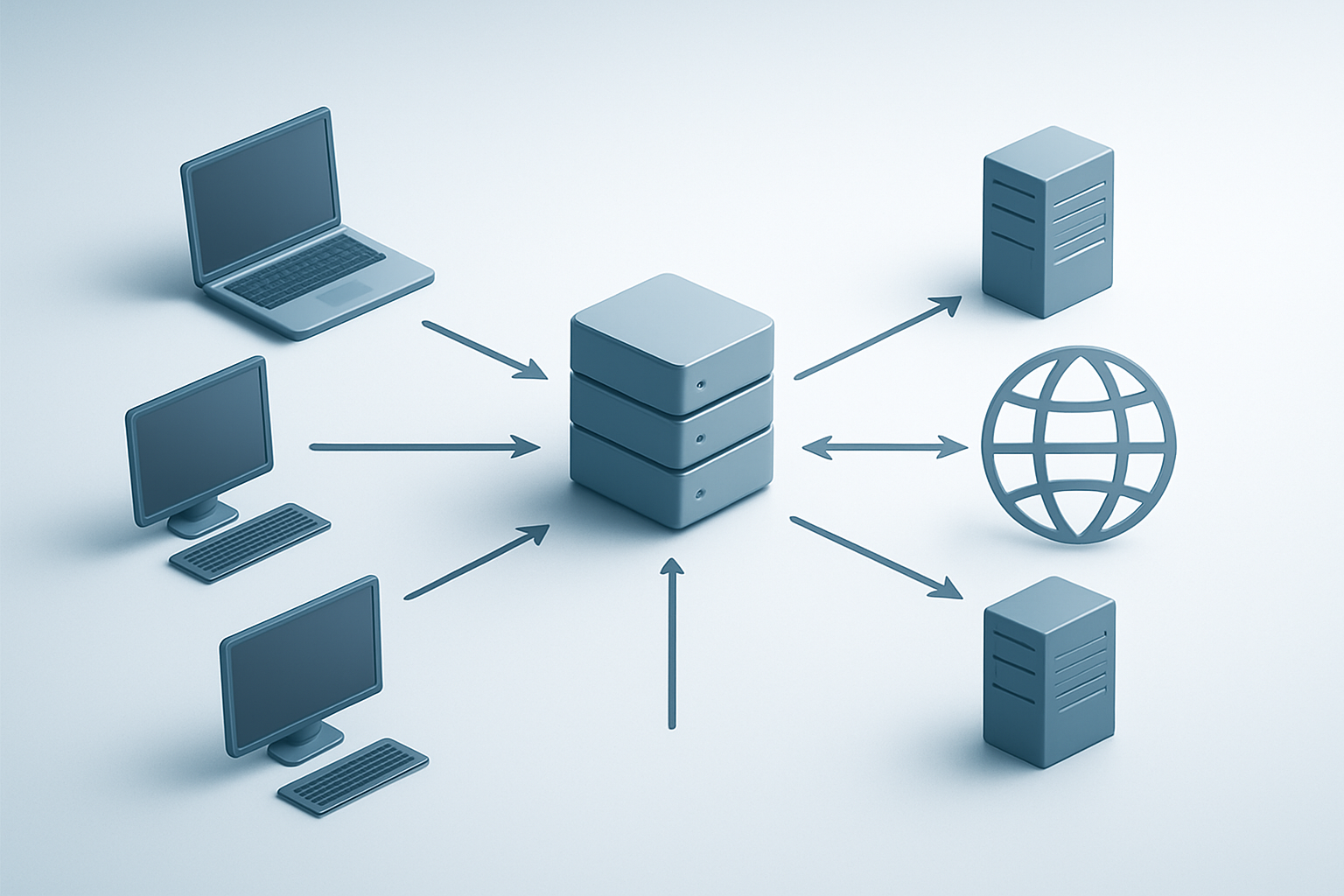
How forward proxies act as intermediaries between clients and servers
A forward proxy sits between your device and the internet, acting like a digital middleman that handles all your web requests. When you type a website URL, your request first goes to the proxy server, which then fetches the content from the destination server and sends it back to you. The target server sees the proxy's IP address instead of yours, creating a layer of separation between your device and the websites you visit.
This proxy vs reverse proxy concept becomes clearer when you understand that forward proxies work on behalf of clients (like your computer), while reverse proxies work on behalf of servers. The forward proxy essentially becomes your representative on the internet, making requests as if it were you but without revealing your actual identity or location.
Key benefits including anonymity, content filtering, and caching
Forward proxies deliver several powerful advantages that make them valuable in both personal and professional settings. Privacy protection stands out as the primary benefit - your real IP address stays hidden from websites, making it harder for them to track your online activities or determine your physical location.
Content filtering capabilities allow organizations to control which websites employees can access during work hours. The proxy server can block social media sites, streaming platforms, or any content deemed inappropriate for the workplace environment. This filtering happens in real-time, examining each request against predefined rules and policies.
Caching functionality speeds up browsing by storing frequently requested web pages locally. When multiple users request the same content, the proxy serves it from its cache rather than fetching it again from the original server. This reduces bandwidth usage and improves response times, especially beneficial in environments with many users accessing similar content.
Bandwidth monitoring and throttling help manage network resources effectively. Administrators can track which users consume the most data and implement speed limits to ensure fair network usage across the organization.
Common use cases in corporate environments and personal browsing
Corporate networks rely heavily on forward proxy explained functionality to maintain security and productivity. Educational institutions use proxies to restrict access to entertainment websites during class hours while allowing educational content to flow freely. Government agencies implement proxies to monitor and control information flow for security purposes.
Personal users often deploy forward proxies to bypass geographical restrictions on streaming content or to access websites blocked in their region. Privacy-conscious individuals use proxy servers to mask their browsing habits from internet service providers and advertisers.
Remote workers connecting to company networks through VPNs often route traffic through corporate proxies to maintain consistent security policies regardless of their physical location.
Real-world example: Company firewall proxy filtering employee internet access
TechCorp, a software development company, implemented a forward proxy solution to balance employee internet freedom with productivity requirements. Their proxy server configuration includes several layers of intelligent filtering that demonstrate practical proxy server types in action.
The system automatically blocks access to gambling and adult content while allowing work-related social media usage during lunch hours. Developers can access GitHub, Stack Overflow, and technical documentation sites without restrictions, but streaming video platforms get throttled during peak business hours.
When Sarah from the marketing team tries to access a blocked website, she sees a customized message explaining the policy and providing contact information for requesting access exceptions. The IT team reviews these requests and can grant temporary or permanent access based on business needs.
The proxy logs show that bandwidth usage dropped by 40% after implementation, while employee complaints about slow internet decreased significantly due to improved caching of frequently accessed technical resources. This real-world implementation showcases how forward proxies create win-win scenarios for both management and employees.
Reverse Proxies Demystified for Better Server Management

How reverse proxies sit between clients and backend servers
A reverse proxy server creates a strategic intermediary layer that fundamentally changes how client requests reach your application servers. Unlike a forward proxy that represents clients to servers, a reverse proxy represents servers to clients. When a user visits your website, they're actually communicating with the reverse proxy, which then decides how to route that request to one or more backend servers.
Picture a busy restaurant where customers never interact directly with the kitchen staff. The waitstaff (reverse proxy) takes orders from customers, communicates with the kitchen (backend servers), and delivers the prepared food back to the table. The customers don't need to know which chef prepared their meal or how many cooks are working in the kitchen.
This architecture provides several advantages for server management. Your backend servers remain completely hidden from external clients, receiving requests only through the controlled reverse proxy layer. The proxy can distribute incoming requests across multiple backend servers, handle connection pooling, and manage server failures transparently without exposing these complexities to end users.
Popular reverse proxy solutions like Nginx, Apache HTTP Server, and cloud-based services like Cloudflare implement this pattern to create robust, scalable web architectures that can handle massive traffic loads while maintaining optimal performance.
SSL termination and encryption handling capabilities
Reverse proxies excel at managing SSL/TLS encryption, taking on the computationally expensive task of encrypting and decrypting HTTPS traffic. This process, known as SSL termination, happens at the proxy layer rather than burdening your backend application servers with cryptographic operations.
When clients establish HTTPS connections, the reverse proxy handles the SSL handshake, certificate validation, and all encryption/decryption processes. Once the secure connection is established with the client, the proxy can communicate with backend servers using plain HTTP over a secure internal network, reducing the computational overhead on your application servers.
This approach offers significant benefits:
-
Performance optimization: Backend servers dedicate resources to application logic instead of encryption tasks
-
Certificate management: Centralized SSL certificate installation and renewal at the proxy level
-
Security compliance: Ensures consistent encryption policies across all backend services
-
Cost efficiency: Reduces the need for expensive SSL processing hardware on every server
Modern reverse proxies support advanced SSL features like HTTP/2, TLS 1.3, and perfect forward secrecy, ensuring your applications benefit from the latest security standards without requiring individual server updates.
Content caching and compression for improved performance
Reverse proxies dramatically improve website performance through intelligent content caching and compression strategies. By storing frequently requested content at the proxy layer, these systems can serve responses directly without hitting backend servers, reducing latency and server load.
Caching strategies vary based on content type and user behavior:
| Content Type | Caching Strategy | Typical TTL |
|---|---|---|
| Static assets (CSS, JS, images) | Aggressive caching | Hours to days |
| Dynamic content | Conditional caching | Minutes to hours |
| API responses | Selective caching | Seconds to minutes |
| User-specific data | No caching or private caching | Variable |
Compression capabilities further enhance performance by reducing bandwidth usage. Reverse proxies automatically compress text-based content using algorithms like Gzip or Brotli before sending responses to clients. This compression can reduce file sizes by 60-80%, significantly improving loading times for users on slower connections.
Smart reverse proxies also implement cache invalidation strategies, automatically updating or purging cached content when backend data changes. This ensures users receive fresh content while maintaining optimal performance through strategic caching.
Security benefits through hiding server infrastructure details
Reverse proxies create a powerful security barrier by completely obscuring your backend infrastructure from external threats. Attackers can't directly target your application servers, databases, or internal network architecture because these systems remain invisible behind the proxy layer.
This security model provides multiple protection layers:
Infrastructure obfuscation: External users never see real server IP addresses, port configurations, or technology stack details. Even if attackers discover vulnerabilities in your application, they can't directly exploit backend servers.
Attack surface reduction: The reverse proxy becomes the only externally accessible component, dramatically reducing potential entry points for malicious actors. You can focus security hardening efforts on a single, well-defined layer.
DDoS protection: Reverse proxies can absorb and filter distributed denial-of-service attacks before they reach backend servers. Many proxy solutions include built-in rate limiting, IP blocking, and traffic analysis capabilities.
Web application firewall integration: Modern reverse proxy solutions integrate WAF functionality, scanning incoming requests for common attack patterns like SQL injection, cross-site scripting, and malformed requests before they reach your applications.
This security architecture allows you to implement defense-in-depth strategies while maintaining optimal performance and scalability for legitimate users.
Load Balancers as Traffic Distribution Powerhouses

Core function of distributing incoming requests across multiple servers
Load balancers act as intelligent traffic controllers that sit between your users and your backend servers. When a request hits your system, the load balancer makes a split-second decision about which server should handle it. This distribution prevents any single server from becoming overwhelmed while others sit idle.
The magic happens through sophisticated request routing. Modern load balancer architecture analyzes incoming traffic patterns, server capacity, and response times to make optimal routing decisions. Unlike reverse proxies that might cache content or modify requests, load balancers focus purely on server load distribution efficiency.
Think of it like a restaurant host managing multiple dining rooms. Instead of cramming everyone into one room while others remain empty, they strategically seat guests across all available spaces to ensure smooth service and prevent bottlenecks.
Different load balancing algorithms and their optimal use cases
Load balancing techniques vary dramatically based on your specific needs and server capabilities. Each algorithm serves different scenarios:
| Algorithm | Best For | How It Works |
|---|---|---|
| Round Robin | Equal server capacity | Distributes requests sequentially across all servers |
| Weighted Round Robin | Mixed server capacities | Assigns more requests to powerful servers |
| Least Connections | Variable request processing times | Routes to server with fewest active connections |
| IP Hash | Session persistence | Uses client IP to consistently route to same server |
| Least Response Time | Performance-critical applications | Directs traffic to fastest-responding server |
Round robin works perfectly when all your servers have identical specifications and handle requests at similar speeds. However, if you're running mixed hardware configurations, weighted algorithms become essential.
Least connections shines when request processing times vary significantly. Database queries or file uploads might take much longer than simple page requests, making connection count a better metric than simple request distribution.
Health checking mechanisms to ensure server availability
Smart load balancers constantly monitor server health through active and passive checks. Active health checks send periodic requests to verify server responsiveness, typically every 30 seconds to 2 minutes. These checks might ping a simple endpoint or request a specific health status page.
Passive monitoring watches real traffic patterns. If a server starts returning errors or response times spike beyond acceptable thresholds, the load balancer automatically removes it from rotation. This prevents users from hitting failed servers while allowing automatic recovery when issues resolve.
Advanced health checking includes:
-
TCP connection tests for basic connectivity
-
HTTP status code monitoring for application-level health
-
Custom endpoint checks that verify database connections
-
SSL certificate validation for secure connections
Most enterprise load balancers provide configurable fail-over policies. You might set rules like "remove server after 3 consecutive failures" or "require 5 successful checks before adding back to pool."
Real-world example: E-commerce site handling Black Friday traffic spikes
Picture an online retailer preparing for Black Friday madness. Their normal traffic of 10,000 concurrent users suddenly explodes to 500,000 shoppers hunting for deals. Without proper load balancing, their servers would crash within minutes.
Smart retailers deploy multiple load balancing layers. Geographic load balancers direct users to the nearest data center, reducing latency. Application load balancers then distribute traffic across dozens of web servers within each location.
During peak shopping hours, the system automatically scales server pools based on demand. When traffic hits the checkout process - typically the most resource-intensive operation - specialized load balancers route payment requests to dedicated high-performance servers optimized for financial transactions.
The load balancer vs reverse proxy distinction becomes crucial here. While reverse proxies might cache product images and static content, load balancers focus on ensuring no single server bears the full weight of purchase processing. Session affinity ensures customers don't lose their shopping carts mid-transaction, while health checks immediately remove any servers struggling under the load.
This multi-layered approach transforms potential site crashes into seamless shopping experiences, protecting both revenue and customer satisfaction during critical sales periods.
Key Differences That Matter for Your Architecture Decisions

Client-facing versus server-facing positioning in network topology
The network positioning of these technologies fundamentally shapes how they interact with users and backend systems. Forward proxies sit between clients and the internet, acting as intermediaries that hide client identities from external servers. When you connect through a forward proxy, websites see the proxy's IP address instead of yours, making it perfect for privacy protection and content filtering in corporate environments.
Reverse proxies operate from the opposite perspective, positioning themselves between external clients and your internal servers. They present a unified front-facing interface while managing multiple backend servers behind the scenes. This server-facing approach enables features like SSL termination, request routing, and response caching that directly benefit your application infrastructure.
Load balancers can function in either position depending on their configuration and deployment scenario. Most commonly, they operate in server-facing positions similar to reverse proxies, distributing incoming requests across multiple application servers. However, some advanced load balancing implementations can also work in client-facing scenarios for specific use cases.
Primary objectives: privacy and filtering versus performance and availability
Each technology serves distinct primary purposes that influence architectural decisions. Forward proxies excel at client-side objectives like privacy protection, content filtering, and bandwidth management. Organizations deploy them to control employee internet access, block malicious websites, and reduce bandwidth consumption through caching frequently accessed content.
Reverse proxies prioritize server-side optimization and security. They handle SSL encryption and decryption, compress responses to reduce bandwidth usage, and provide an additional security layer by hiding internal server details from external threats. Popular reverse proxy solutions like Nginx and Apache HTTP Server offer robust caching mechanisms that dramatically improve response times for static and dynamic content.
Load balancers focus exclusively on availability and performance optimization. They ensure no single server becomes overwhelmed by distributing traffic intelligently across multiple instances. Modern load balancers implement health checks to automatically route traffic away from failing servers, maintaining high availability even during hardware failures or maintenance windows.
| Technology | Primary Focus | Key Benefits |
|---|---|---|
| Forward Proxy | Client Privacy & Control | Content filtering, IP masking, bandwidth management |
| Reverse Proxy | Server Optimization & Security | SSL termination, caching, security layer |
| Load Balancer | High Availability & Performance | Traffic distribution, failover, scalability |
Scalability implications for high-traffic applications
When planning for high-traffic scenarios, each technology scales differently and addresses specific bottlenecks. Forward proxies typically handle scalability through horizontal scaling, adding more proxy servers to accommodate increasing client requests. However, they can become bottlenecks themselves if not properly dimensioned, especially when performing intensive content filtering or virus scanning operations.
Reverse proxy scalability involves both vertical and horizontal scaling approaches. You can increase server resources to handle more concurrent connections or deploy multiple reverse proxy instances behind their own load balancer. High-performance reverse proxies like Nginx can handle thousands of concurrent connections efficiently, making them excellent choices for high-traffic web applications.
Load balancers represent the gold standard for application scalability, enabling virtually unlimited horizontal scaling by adding more backend servers to the pool. Modern load balancing algorithms like least connections, weighted round-robin, and resource-based routing ensure optimal traffic distribution even as your infrastructure grows. Cloud-based load balancers can automatically scale based on traffic patterns, handling sudden traffic spikes without manual intervention.
The key difference in scalability planning lies in understanding that forward proxies scale to support more clients, reverse proxies scale to handle more requests per client, and load balancers scale to support more backend capacity. Combining these technologies creates robust, scalable architectures capable of handling enterprise-level traffic volumes while maintaining optimal performance and availability.
Real-World Implementation Scenarios and Best Practices

When to choose a forward proxy for organizational control
Forward proxies excel in environments where content filtering, bandwidth management, and user activity monitoring are priorities. Companies dealing with sensitive data often deploy forward proxy configurations to prevent data exfiltration and monitor outbound communications. Financial institutions, government agencies, and healthcare organizations commonly implement forward proxies to ensure compliance with regulatory requirements like HIPAA, SOX, or GDPR.
Schools and educational institutions leverage forward proxies to filter inappropriate content while tracking student internet usage patterns. The proxy server acts as a gatekeeper, blocking access to social media during study hours or preventing downloads of potentially harmful software. Manufacturing companies use forward proxies to protect proprietary information by monitoring and controlling which external websites employees can access.
Corporate networks benefit from forward proxies when implementing geolocation-based access controls. Teams working on international projects can bypass regional restrictions while maintaining security oversight. The proxy configuration allows IT administrators to create detailed access policies based on user roles, departments, or project requirements.
Optimal reverse proxy deployment for web application security
Reverse proxy server implementations provide robust security layers for web applications by hiding backend infrastructure details from external users. SSL/TLS termination at the reverse proxy level reduces computational load on application servers while centralizing certificate management. This approach simplifies security updates and ensures consistent encryption standards across multiple backend services.
Web application firewalls (WAF) integrate seamlessly with reverse proxy architectures, filtering malicious requests before they reach application servers. DDoS protection becomes more effective when reverse proxies distribute attack traffic across multiple backend instances or redirect suspicious requests to honeypots.
Content caching at the reverse proxy level improves response times while reducing server load. Static assets, API responses, and frequently requested pages get served directly from proxy cache, allowing backend servers to focus on dynamic content generation. Geographic load distribution becomes possible when multiple reverse proxies operate in different regions, serving cached content closer to end users.
Rate limiting and API throttling protect backend services from abuse. The reverse proxy can implement sophisticated rate limiting rules based on IP addresses, user authentication tokens, or API key usage patterns.
Load balancer selection criteria for mission-critical systems
Mission-critical applications require load balancers that provide high availability, automatic failover, and health monitoring capabilities. Layer 7 (application layer) load balancers offer advanced traffic routing based on HTTP headers, cookies, or URL paths, making them ideal for microservices architectures where different services handle specific request types.
Session persistence becomes crucial for applications maintaining user state. Sticky sessions ensure users consistently connect to the same backend server, while session replication allows load balancers to redistribute traffic without losing user data. Database connection pooling through load balancers prevents connection exhaustion on database servers.
Health check configurations must account for application-specific requirements. Simple ping tests aren't sufficient for complex applications; custom health endpoints that verify database connectivity, cache availability, and external service dependencies provide more accurate server status information.
Geographic considerations impact load balancer architecture decisions. Global server load distribution requires DNS-based routing combined with regional load balancers. Latency-based routing algorithms ensure users connect to the nearest available server cluster.
| Load Balancer Type | Best Use Case | Key Features |
|---|---|---|
| Hardware | High-throughput applications | Dedicated processing power, advanced SSL acceleration |
| Software | Cloud-native applications | Flexible configuration, auto-scaling integration |
| Cloud-based | Distributed systems | Global load distribution, managed maintenance |
Hybrid approaches combining multiple solutions for enterprise needs
Enterprise architectures often combine proxy vs reverse proxy configurations with load balancing techniques to create comprehensive traffic management solutions. A typical setup might include forward proxies for outbound traffic control, reverse proxies for application security, and load balancers for traffic distribution.
Multi-tier proxy configurations provide defense in depth. Forward proxies handle outbound security, while reverse proxies manage inbound traffic. Load balancers sit between reverse proxies and application servers, ensuring optimal resource utilization. This layered approach allows different teams to manage their respective components while maintaining overall system integrity.
Cloud-hybrid deployments benefit from combining on-premises load balancers with cloud-based reverse proxy services. Traffic routing rules can direct certain requests to on-premises infrastructure while leveraging cloud elasticity for peak load handling. This approach provides cost optimization while maintaining performance standards.
Container orchestration platforms like Kubernetes integrate multiple proxy types through ingress controllers and service meshes. These solutions combine load balancer architecture principles with reverse proxy benefits, providing service discovery, traffic encryption, and observability features. Microservices communication gets secured and optimized through intelligent routing policies that consider service health, latency, and resource availability.
API gateways represent another hybrid approach, combining reverse proxy functionality with authentication, rate limiting, and API versioning capabilities. These solutions centralize API management while providing the traffic distribution benefits of traditional load balancers.

All three technologies—forward proxies, reverse proxies, and load balancers—serve distinct purposes in modern web architecture, but they often work together to create robust, scalable systems. Forward proxies help organizations control outbound traffic and enhance security, while reverse proxies excel at optimizing server performance through caching, SSL termination, and request routing. Load balancers take center stage when you need to distribute incoming traffic across multiple servers to prevent bottlenecks and maintain high availability.
The key to success lies in understanding when and how to use each tool. Small applications might only need a reverse proxy for basic optimization, while enterprise-level systems often combine all three technologies for maximum performance and security. Before making your choice, consider your specific requirements: traffic volume, security needs, scaling plans, and budget constraints. Start with the basics and gradually add complexity as your system grows—this approach will help you build a solid foundation that can evolve with your needs.


Comments
Post a Comment